Sunscreen is often presented as a simple solution: apply SPF, go outside, stay protected.
But for many people, especially those with very fair skin, the reality feels more frustrating. They apply sunscreen, reapply it, choose SPF 50, avoid staying out too long—and still burn.
So does that mean the sunscreen is not working?
Not necessarily.
In many cases, SPF is working, but not in the way people expect it to.
SPF reduces risk. It does not make skin immune.
One of the biggest misunderstandings about sunscreen is the idea that SPF creates a protective shield that completely blocks the sun.
It does not.
SPF mainly measures protection against UVB rays, the rays most closely linked to sunburn. SPF 50 allows roughly around 2% of UVB rays through when applied correctly, while SPF 100 allows around 1%. That sounds like a small difference, and in many cases it is. But for very fair skin, even small amounts of UV exposure can matter.
This is why someone with very pale skin may still burn despite using SPF 50, especially during high UV hours or long outdoor exposure.
The amount matters more than most people think.
Sunscreen testing is based on a generous amount of product. In real life, most people apply much less.
The American Academy of Dermatology recommends that most adults use about one ounce of sunscreen—roughly a shot glass amount—to cover exposed skin, and at least one teaspoon for the face.
This matters because applying half the needed amount does not simply give you “half protection.” It can reduce the actual protection dramatically.
So when someone says SPF 50 is not working, one of the first questions is not which SPF they bought, but how much they actually applied.
Reapplication is not optional.
Even a good sunscreen does not stay perfectly protective all day.
It can break down, rub off, move with sweat, or be removed by swimming and towel drying. The FDA recommends reapplying sunscreen at least every two hours, and more often when sweating or swimming.
This is especially important for people who burn easily. Reapplying once during a long day outside may not be enough.
Broad spectrum matters.
Another issue is that people often focus only on the SPF number.
But SPF is not the whole story.
A good sunscreen should be broad spectrum, meaning it protects against both UVA and UVB rays. UVB is strongly linked to sunburn, while UVA contributes to deeper skin damage, premature aging, and long-term exposure effects. The FDA specifically recommends broad-spectrum sunscreen as part of sun protection.
So a high SPF product with weak UVA protection may still leave the skin underprotected in a broader sense.
SPF 100 may help—but it is not magic.
There is a common argument online that SPF 100 is “not worth it” because the difference from SPF 50 is small.
For many people, SPF 50 is enough when used properly.
But for someone who is extremely fair, burns easily, or spends time in intense sun, SPF 100 may provide a slightly larger safety margin. The Skin Cancer Foundation recommends water-resistant, broad-spectrum SPF 50 or higher for extended outdoor activity.
The important point is this: SPF 100 does not replace correct application, reapplication, shade, hats, or protective clothing.
Some skin needs more than sunscreen.
For very fair skin, sunscreen should be one part of sun protection—not the whole plan.
The FDA recommends limiting time in the sun, especially between 10 a.m. and 2 p.m., and using protective clothing, sunglasses, and broad-brimmed hats along with sunscreen.
This is especially relevant for people with very pale skin, red hair, or a history of burning easily.
In these cases, the best protection often comes from layering strategies:
sunscreen, shade, UPF clothing, hats, and timing.
The real problem may not be the product.
When SPF “doesn’t work,” the issue is often not that the sunscreen is fake or useless.
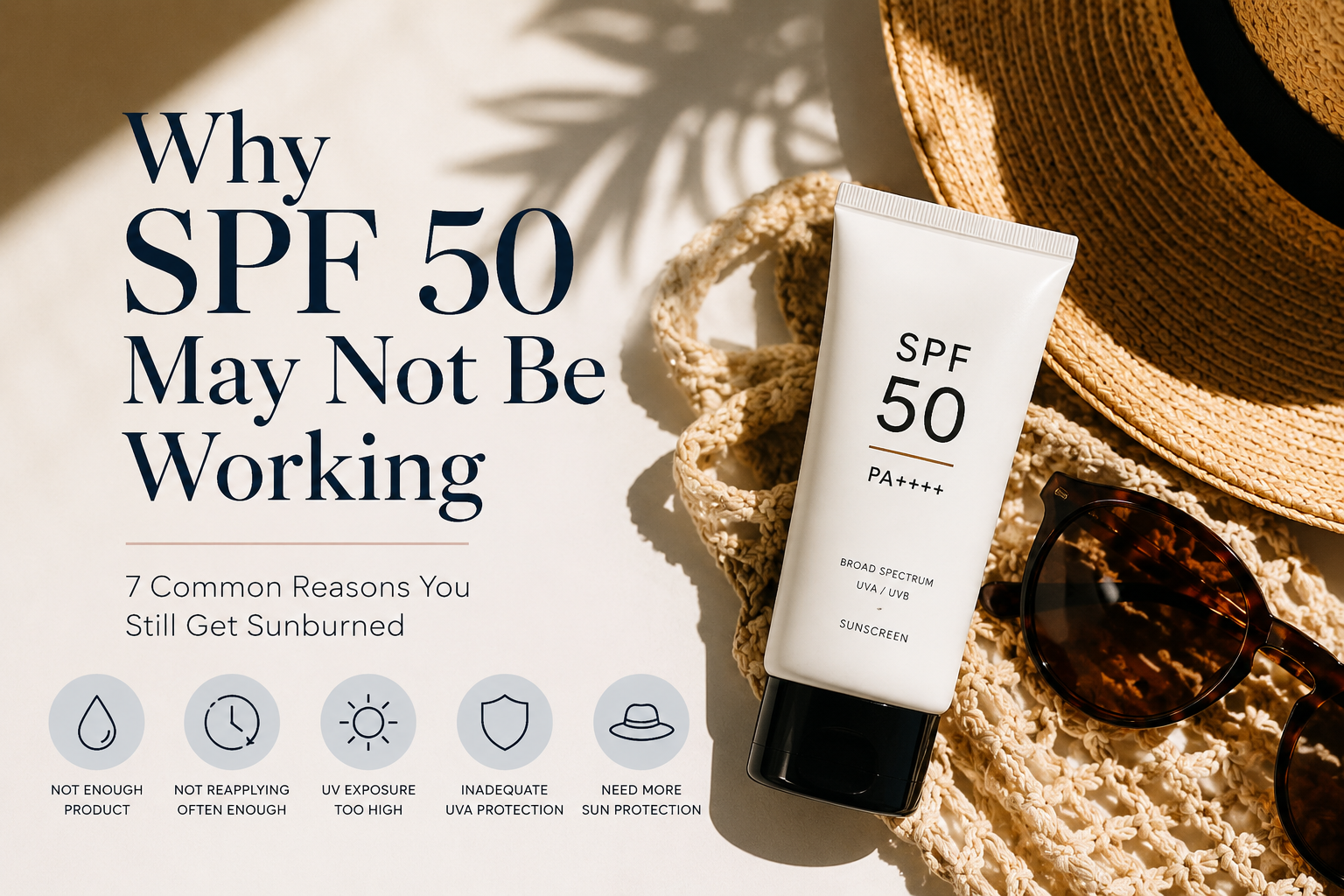
More often, it is one of these:
the amount is too low
the product is not reapplied often enough
the sun exposure is too intense
the formula is not water-resistant
the sunscreen is rubbing off
the skin is extremely sun-sensitive
the product lacks strong broad-spectrum protection
Sunscreen works best when people understand its limits.
The takeaway
SPF 50 is strong protection, but it is not a guarantee against sunburn.
For many people, especially those with very fair skin, the goal should not be to find a sunscreen that allows unlimited sun exposure. The goal is to build a smarter protection routine.
Use enough product. Reapply often. Choose broad spectrum. Look for water resistance when needed. Add shade, hats, and UPF clothing.
Because sunscreen is powerful—but it was never meant to work alone.
Sources
- American Academy of Dermatology (AAD) – Sunscreen application guidelines
https://www.aad.org/public/everyday-care/sun-protection/shade-clothing-sunscreen/how-to-apply-sunscreen - U.S. Food & Drug Administration (FDA) – Sunscreen and sun protection recommendations
https://www.fda.gov/drugs/understanding-over-counter-medicines/sunscreen-how-help-protect-your-skin-sun - UC Davis Health – Understanding SPF and sunscreen protection
https://health.ucdavis.edu/blog/cultivating-health/what-you-should-know-about-sunscreen-spf-and-protecting-your-family/2022/06 - The Skin Cancer Foundation – High SPF sunscreen explained
https://www.skincancer.org/blog/ask-the-expert-does-a-high-spf-protect-my-skin-better/