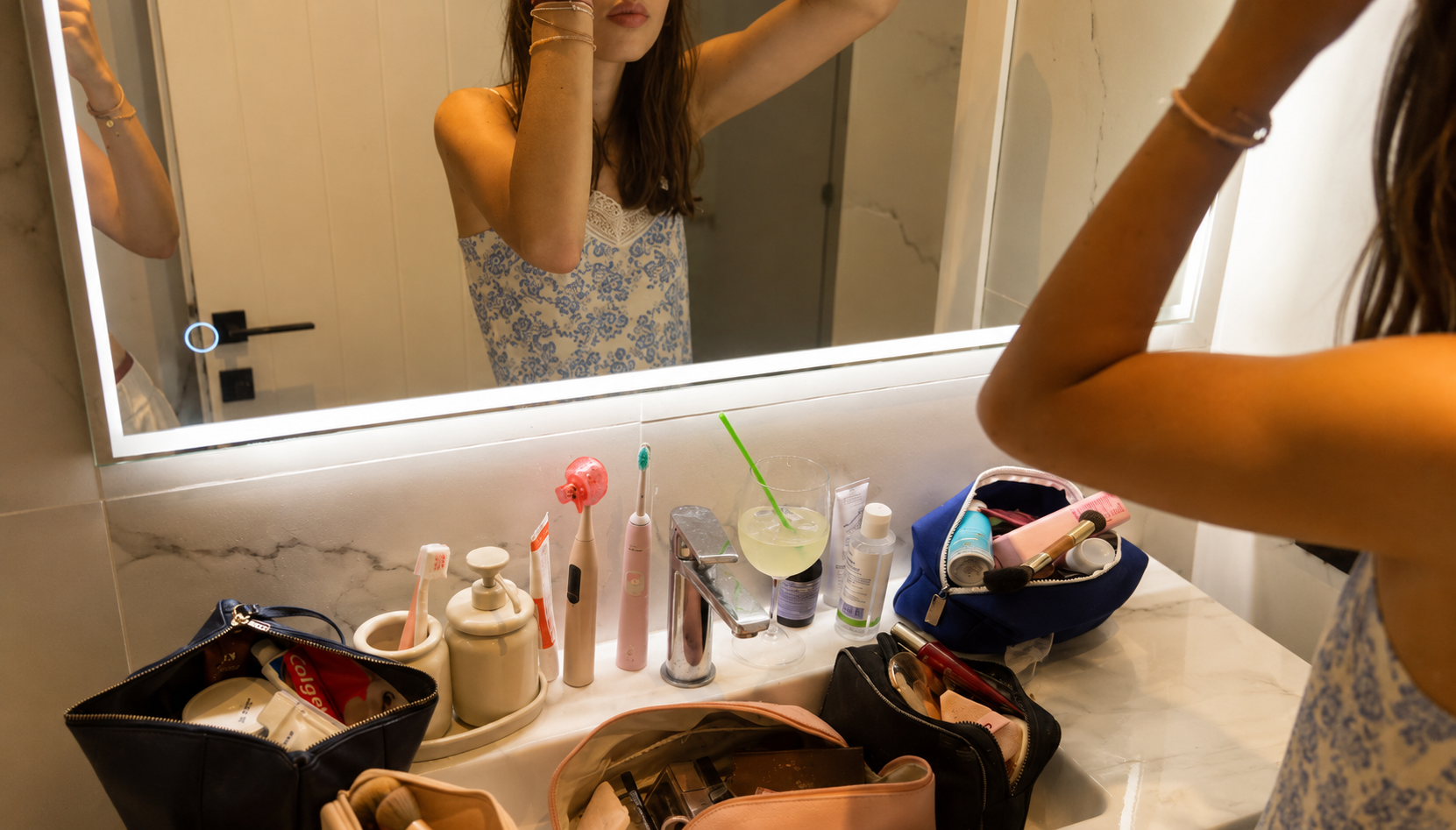
There was a time when a child’s bathroom shelf held toothpaste, shampoo and perhaps a brightly colored lip balm. Today, it may also contain cleansers, serums, face mists, masks and products promising brighter, smoother or more “glowing” skin.
The obvious question is: how young is too young for skincare?
But perhaps that is the wrong question.
Washing your face is skincare. Moisturizing dry skin is skincare. Sunscreen is skincare. None of these suddenly become appropriate on a particular birthday. The more useful question is what kind of skincare does young skin actually need – and when does care turn into unnecessary correction?
Young Skin Needs Care Long Before It Needs Correction
Children and teenagers are not simply smaller adults when it comes to skincare. Their skin is still developing, and its needs change significantly as puberty begins.
For most tweens without a specific skin condition, the American Academy of Dermatology recommends something remarkably uncomplicated: a gentle cleanser, a fragrance-free moisturizer when needed and broad-spectrum SPF 30 or higher. As puberty progresses, increased oil production and acne may create a reason to introduce additional ingredients or treatments.
In other words, starting skincare young isn’t necessarily the problem.
Starting the wrong skincare young can be.
A 10-year-old learning to apply sunscreen before spending the day outside is building a useful lifelong habit. A 10-year-old worrying about collagen loss, fine lines and whether her pores look sufficiently invisible is something very different.
And that distinction is becoming increasingly important.
Children Didn’t Suddenly Develop More Skincare Needs
They simply began seeing much more skincare.
A 2026 study of high-school students found that 94.9% had used facial skincare products within the previous 24 hours. Greater social-media use and viewing beauty tutorials were associated with using more personal-care products, while 41% of participants reported buying products after seeing them used on social media.
Another 2026 study involving people aged 11 to 21 found similarly widespread skincare use. TikTok was the most commonly reported source of skincare information, and around half of participants reported experiencing adverse reactions to products.
None of this means that social media invented teenage skincare. Acne, oily skin and the desire to experiment with beauty existed long before TikTok.
What has changed is the amount of information – and marketing – a young person encounters before they have developed the experience to separate skin health from beauty optimization.
A child can now hear about enlarged pores, pigmentation, skin texture, collagen loss, barrier repair and premature aging before any of these things have meaningful relevance to their own skin.
Normal skin texture can start looking like something that needs fixing simply because the skin on a screen rarely looks normal.
The Six-Product Routine for a 13-Year-Old
One study published in Pediatrics illustrates the problem particularly well. Researchers created TikTok accounts posing as 13-year-old users and analyzed skincare routine videos shown to them.
The average routine contained six products and cost approximately $168. Only 26.2% of the videos included sunscreen. Among the most-viewed videos, routines contained numerous potentially irritating active ingredients, and potential contact allergens were common.
There is something almost perfectly backwards about that.
One of the least glamorous skincare products – sunscreen – is also one of the most useful habits to establish early. Yet a complicated collection of attractive bottles makes much better content.
That is the difference between skincare as health and skincare as entertainment.
The latter isn’t automatically bad. Skincare can be fun. A teenager can enjoy choosing a moisturizer or trying a gentle face mask without turning it into a dermatological crisis.
The problem begins when fun starts convincing young people that healthy skin is unfinished skin.
Why Does a Child Need Anti-Aging?
This may be the strangest part of the trend.
Retinoids, exfoliating acids, strong vitamin C formulations and other active products have legitimate uses. Some are even prescribed by dermatologists to younger patients for specific conditions such as acne.
But that is very different from a child using an anti-aging product because an algorithm suggested that everyone needs one.
The American Academy of Dermatology specifically cautions that tweens generally don’t need active ingredients aimed at concerns such as wrinkles, sun damage or uneven tone unless there is a specific reason and appropriate professional guidance.
There is an obvious skin-health argument here: unnecessary actives can irritate young skin.
But there is also a cultural question worth asking.
What are we telling children when we sell them anti-aging before they have finished growing up?
Skincare should not teach an 11-year-old to inspect her face for evidence of a future she needs to prevent.
There will be plenty of time later in life to think about aging.
Childhood doesn’t need an anti-aging strategy.
Don’t Kill the Curiosity
There is another extreme that isn’t particularly helpful either.
Imagine a 12-year-old asking a parent for skincare after seeing routines online. Responding with “You don’t need any of that nonsense” probably won’t make the interest disappear. The tutorials, influencers and product recommendations will still be there tomorrow.
Curiosity can actually be useful.
Instead of shutting the conversation down, it can become an opportunity to ask a much better question together:
What does your skin actually need?
Perhaps the answer is a gentle cleanser, moisturizer and sunscreen. That may not look as exciting as an eight-step routine, but it is still a routine — and one built around taking care of healthy skin rather than searching for imperfections.
If acne, eczema, persistent irritation or another skin problem appears, the conversation changes. Then the goal isn’t to find whichever serum is currently viral, but to understand what is happening and, when appropriate, get advice from a qualified healthcare professional.
The point isn’t to keep young people away from skincare.
It is to help them learn the difference between caring for their skin and constantly trying to improve it.
So, When Should Skincare Start?
There is no single birthday when skincare suddenly becomes appropriate.
Healthy habits can begin early. Gentle cleansing when needed, moisturizing dry skin and protecting skin from excessive sun exposure are not adult beauty rituals. They are basic care.
As adolescence brings oiliness, acne or other changes, a routine may need to evolve too. But it should evolve because the skin’s needs changed, not simply because another product appeared in a feed.
Perhaps that is the simplest rule worth teaching early:
Your skincare routine doesn’t need to contain everything skincare has to offer. It only needs to contain what your skin needs.
So maybe the better question isn’t “When should skincare start?”
It is:
“What does this skin actually need right now?”
For young skin, the answer may be refreshingly boring: keep it clean, keep it comfortable, protect it from the sun – and let it be young.