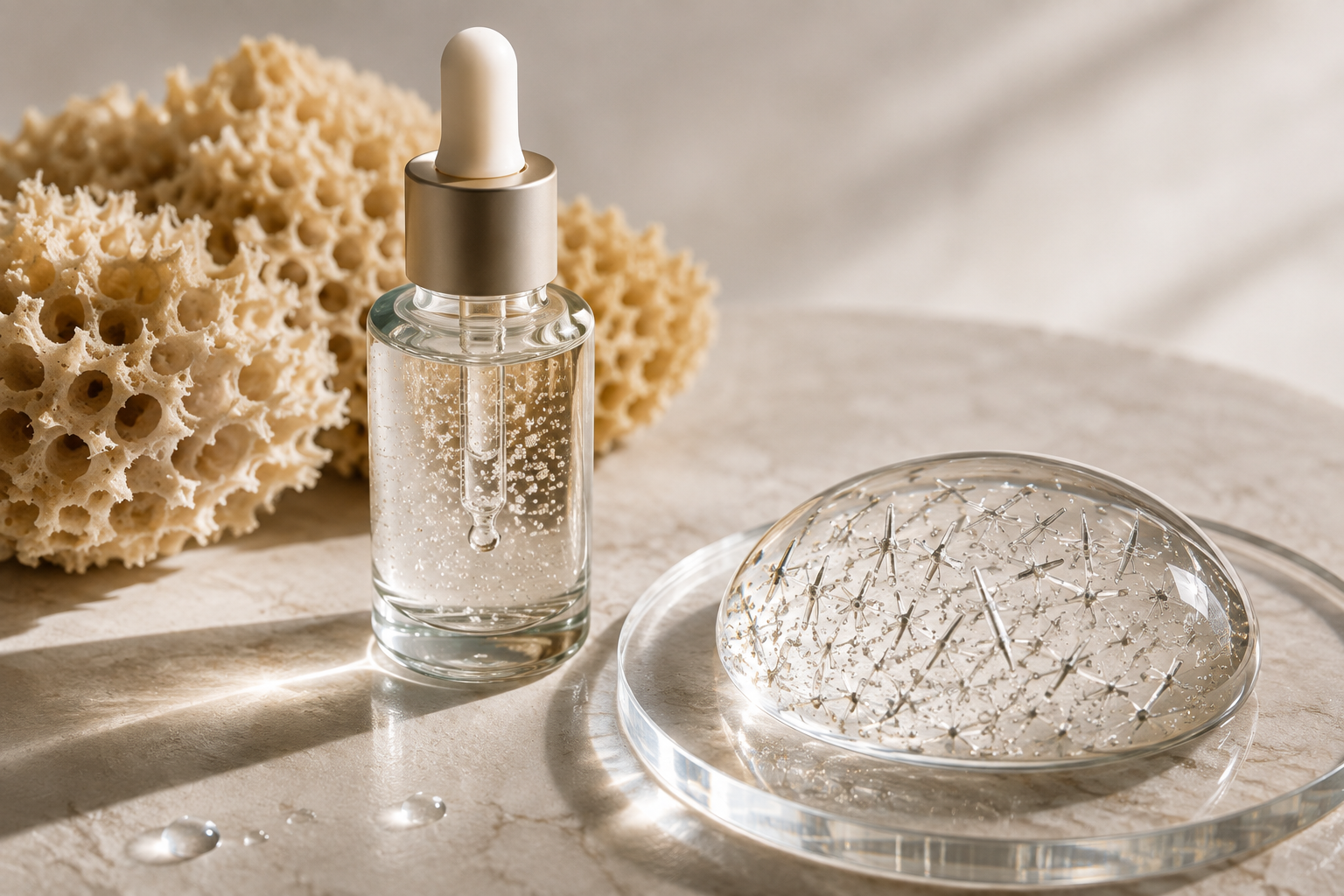
You apply a serum. A few seconds later, your skin starts to prickle.
There is no device, no roller and certainly no visible needle involved. Yet the sensation can be surprisingly convincing.
Welcome to one of skincare’s stranger recent obsessions: spicules.
They are appearing in products described online as everything from “liquid microneedling” to “microneedling in a bottle”. The promise sounds almost too good to ignore — some of the benefits associated with a professional treatment, delivered through an ordinary skincare product at home.
Except that is not quite what is happening.
And the reality may actually be more interesting than the marketing.
So, What Exactly Are Spicules?
Despite their futuristic reputation, spicules are not a newly invented high-tech skincare ingredient.
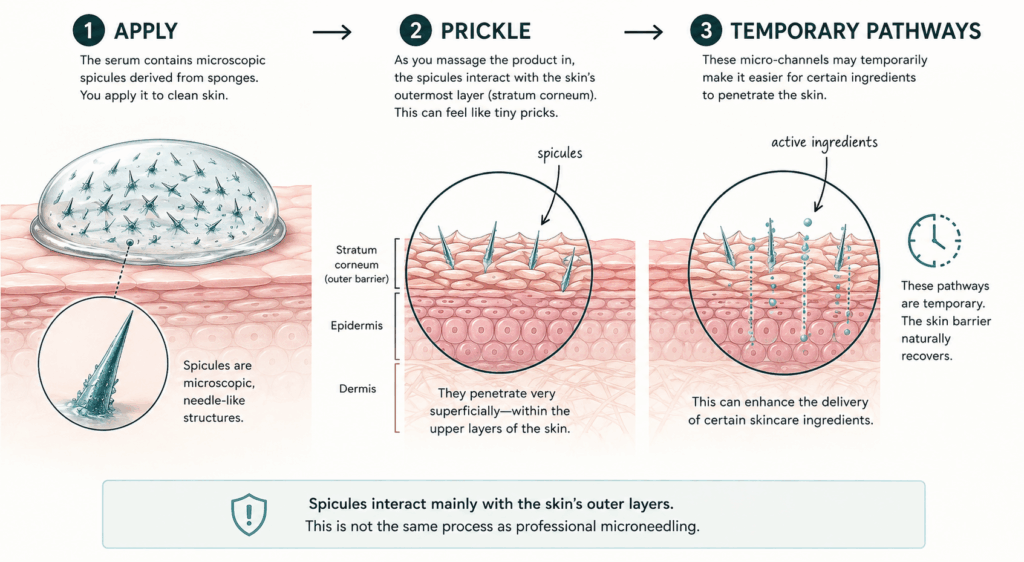
Many of those used in skincare are microscopic, needle-like structures derived from marine or freshwater sponges. In nature, these tiny structures form part of the sponge’s supporting skeleton. In skincare, they can be processed and incorporated into topical formulas.
So yes: some of the microscopic things making your expensive serum feel prickly started life as part of a sponge.
But spicules are interesting for more than their unusual origin.
Unlike an ingredient that simply dissolves into a formula, they can physically interact with the surface of the skin.
And that is where things get interesting.
Why Can You Actually Feel Them?
Our skin is very good at keeping things out.
Its outermost layer acts as a protective barrier, which is useful for staying alive but slightly inconvenient when you are trying to convince skincare ingredients to travel further into it.
Spicules can temporarily disrupt that surface barrier by creating microscopic pathways. Researchers have therefore been studying them as a possible way of improving the delivery of substances through the skin. Recent research continues to investigate sponge spicules for delivering peptides, proteins and other larger molecules — well beyond ordinary cosmetic serums.
That also helps explain the strange prickling sensation.
There really are microscopic, rigid structures interacting with your skin.
So this is not one of those beauty trends where absolutely nothing is happening.
Something is happening.
The more important question is what that something actually means for your skin.
Is This Really “Microneedling in a Bottle”?
Not really.
Professional microneedling uses controlled needles to penetrate the skin at specific depths. It is designed to trigger processes involved in wound healing and collagen remodelling and is used for concerns including scars and skin texture.
Spicule skincare works differently.
The action is generally much more superficial, and dermatologists caution that it should not be considered an at-home replacement for professional microneedling.
The comparison makes sense visually: tiny sharp structures interact with the skin in both cases.
But that does not make the two treatments equivalent.
Calling spicules “microneedling in a bottle” is therefore a clever way of explaining the concept.
Taking the phrase literally is another matter.
Better Absorption Sounds Great. But Is It Always?
This may be the most interesting question surrounding spicule skincare.
One of their biggest selling points is that they may help other ingredients penetrate the skin more effectively. And there is genuine research behind spicules as a delivery technology.
But there is an odd contradiction here.
We spend enormous amounts of money trying to protect and strengthen the skin barrier.
Then we become excited about another product because it can temporarily make that barrier easier to cross.
That does not automatically make spicules bad. It simply means that “better penetration” should not be treated as an unquestionable benefit.
What else are you applying at the same time?
How frequently are you using the product?
And does your skin actually need that additional irritation?
These questions matter particularly for people with sensitive skin or conditions such as eczema and rosacea. Dermatologists have also advised caution when combining spicule products with potentially irritating ingredients such as strong exfoliants or retinoids.
More is not always better — even when you can physically feel it working.
Why We Love Skincare We Can Feel
And perhaps this explains part of the fascination.
Beauty has always had an interesting relationship with sensation.
An acid tingles.
A peel burns slightly.
A mask tightens.
A spicule serum prickles.
Those sensations make a product feel active. They give us immediate feedback that something is happening — long before we could possibly see a meaningful change in the skin.
But feeling a product work and proving that it works are two very different things.
The strongest spicule product is not automatically the most effective one. And tolerating more discomfort is not a skincare achievement.
The prickling tells us that the spicules are physically interacting with the skin.
It does not, by itself, tell us what the final result will be.
Clever Science or Clever Marketing?
Probably both.
Spicules are genuinely interesting.
Scientists are actively exploring sponge-derived structures as delivery systems, including applications that go far beyond cosmetics. Research published in 2026, for example, has continued investigating modified sponge spicules for delivering larger biological molecules through the skin.
That makes them considerably more interesting than a skincare buzzword invented purely for social media.
But the science of spicule-based delivery and the claim that a cosmetic serum gives you “microneedling in a bottle” are not the same thing.
For now, perhaps the fairest way to look at spicules is as an unusual and promising skincare technology — not a professional treatment hiding inside a serum.
And maybe that should be interesting enough without pretending otherwise.