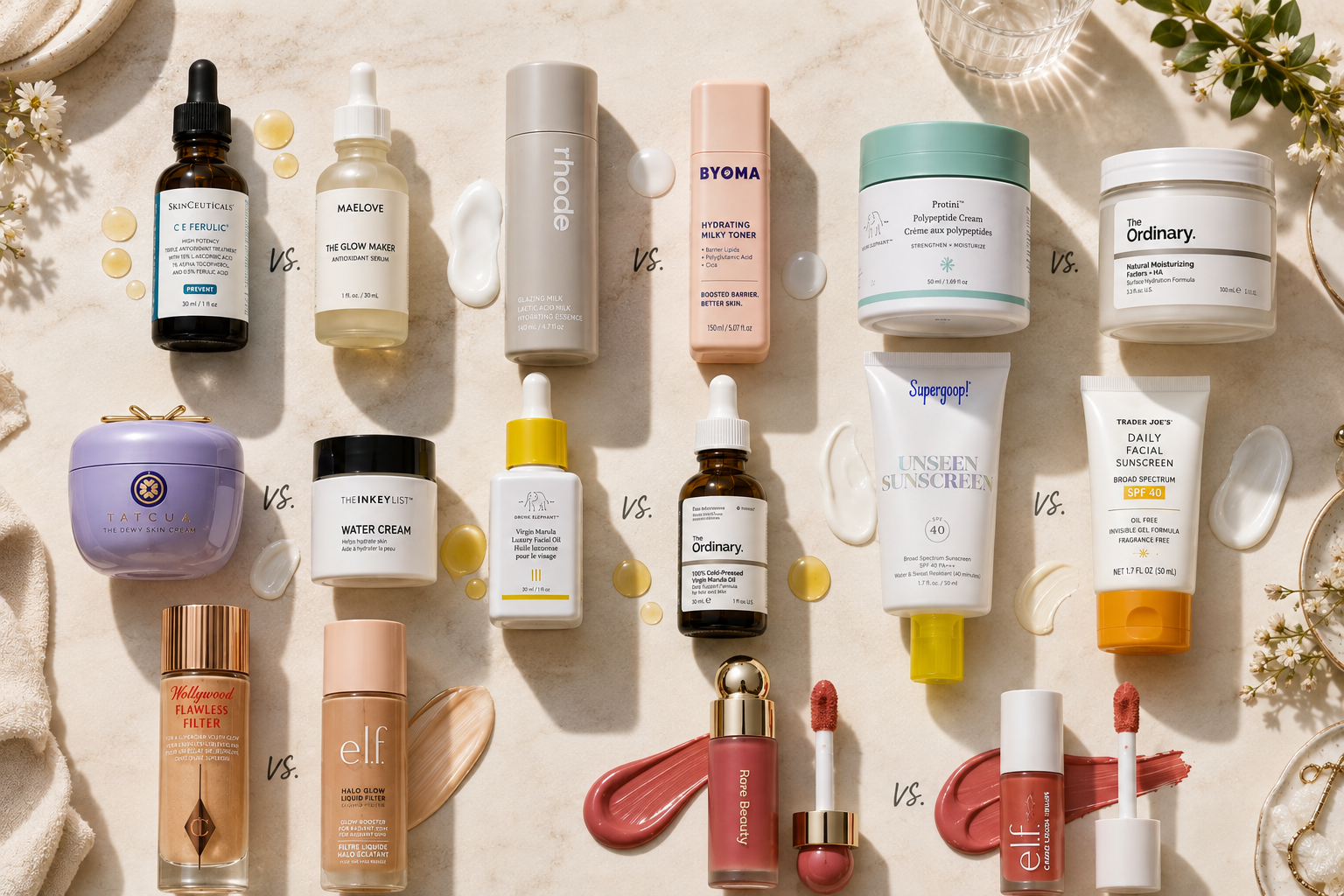
The word dupe has become part of the everyday beauty vocabulary.
Type the name of almost any expensive skincare product into Google, TikTok or Reddit and add that one word. Chances are, someone has already found a cheaper alternative.
Sometimes the comparison seems almost too good to ignore. A serum that costs a fraction of the original. A moisturiser with similar hero ingredients. A facial oil that appears almost identical on paper.
But there is a problem.
What exactly makes one skincare product a dupe for another?
With makeup, the answer can be relatively simple. If two blushes create a similar colour, finish and wear, many people will happily call one a dupe for the other. Skincare is more complicated.
Two products can share several ingredients and still have very different formulas. They can look similar, feel similar and even promise similar results without working in quite the same way.
So instead of asking which expensive products have cheaper copies, we wanted to ask a different question:
How similar are some of the internet’s most talked-about beauty dupes, really?
What Does “Dupe” Actually Mean in Skincare?
There is no official definition of a beauty dupe.
Online, the term can describe several very different kinds of similarity. Sometimes two products share important ingredients. In other cases, they have a similar texture or leave a similar finish on the skin.
A dupe may therefore recreate the formula, the texture, the effect or simply the experience of using another product.
Those distinctions matter in skincare.
A moisturiser does not need an identical ingredient list to produce a similar hydrated finish. At the same time, two serums containing the same headline ingredients are not automatically interchangeable.
With that in mind, we looked at eight frequently compared pairs — six skincare examples and two of beauty’s best-known makeup dupes.
Rather than simply choosing a cheaper winner, we asked what each alternative is actually duplicating.
1.SkinCeuticals C E Ferulic vs. Maelove The Glow Maker
Few skincare products have inspired as much dupe hunting as SkinCeuticals C E Ferulic.
Its combination of vitamin C, vitamin E and ferulic acid has made it one of the most recognisable antioxidant serums in premium skincare. Its price has also made it an obvious target for cheaper alternatives.
Maelove The Glow Maker is frequently placed in that conversation. At first glance, the comparison makes sense. Both formulas centre on antioxidant protection and use the familiar combination of vitamins C and E with ferulic acid.
Yet matching the headline ingredients tells only part of the story.
Vitamin C formulas are particularly sensitive to factors such as concentration, pH, stability, supporting ingredients, packaging and formulation. Even when two ingredient lists look remarkably familiar, the finished products are not necessarily identical.
That makes The Glow Maker an interesting alternative rather than an automatic copy.
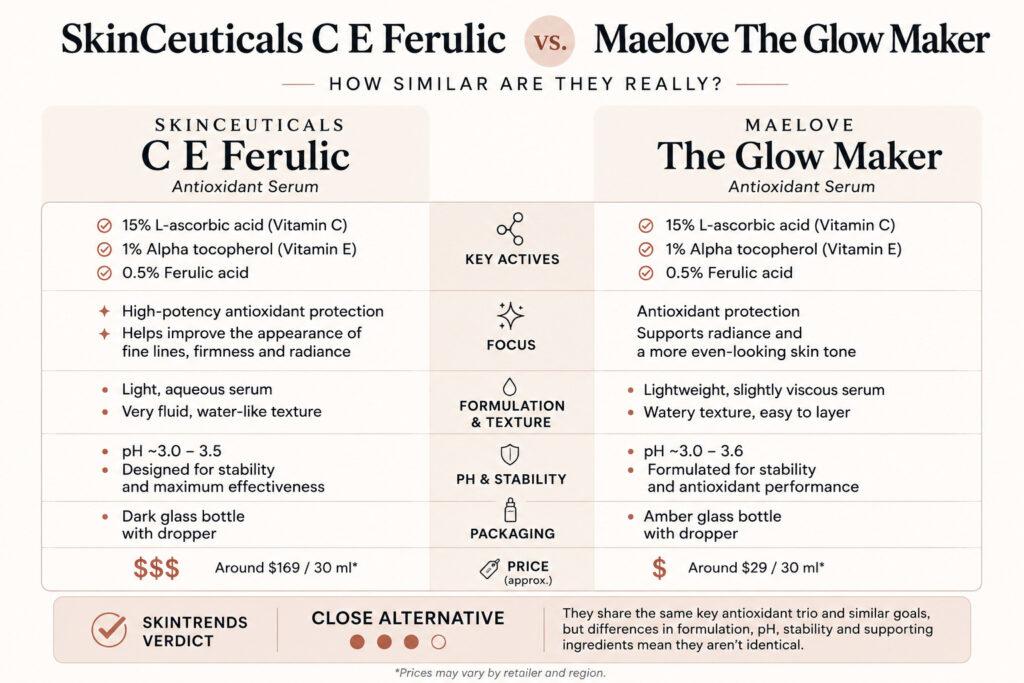
CLOSE ALTERNATIVE
The comparison shows one of the central problems with skincare dupes: similar hero ingredients can point in the same direction without creating exactly the same product.
2.Rhode Glazing Milk vs. BYOMA Hydrating Milky Toner
Milky skincare has become difficult to miss.
Rhode Glazing Milk helped turn the creamy, fluid step between cleansing and moisturising into one of skincare’s most recognisable recent formats. As the category expanded, BYOMA Hydrating Milky Toner became one of the products regularly mentioned as a more affordable alternative.
Visually, the comparison is easy to understand. Both fit into the milky hydration trend and focus heavily on keeping skin comfortable and supported.
But their similarities do not make them interchangeable.
The products approach hydration and barrier support through different formulations, and their textures and skin feel are not identical. Even their positioning is slightly different: one is presented as an essence-like treatment, while the other sits more naturally within the toner category.
This is where the meaning of dupe begins to stretch.
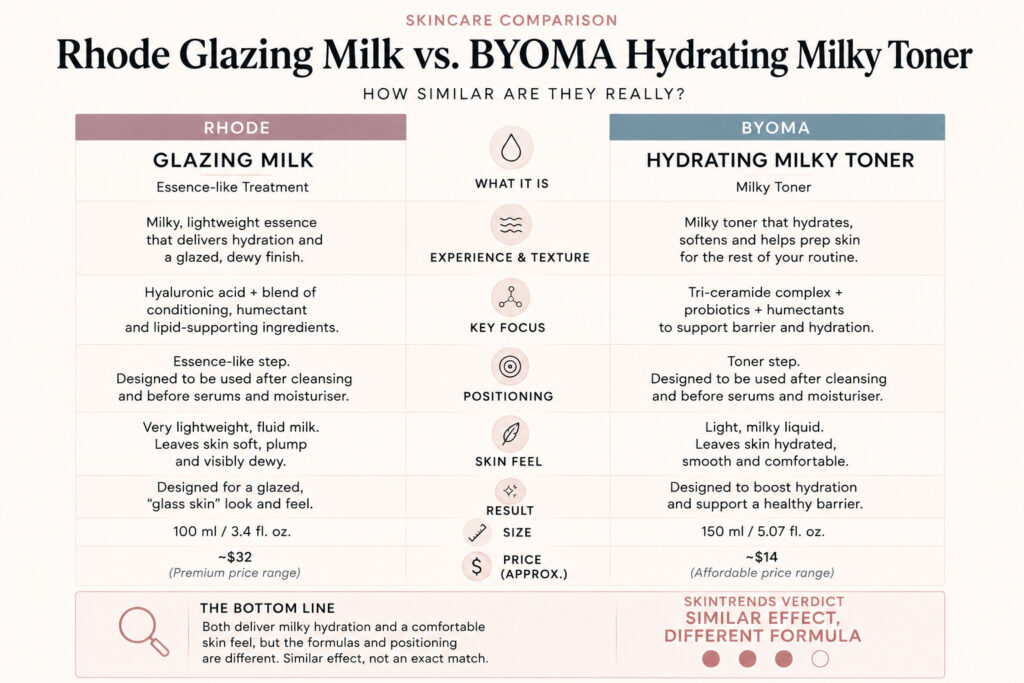
If someone wants the broader experience of adding a lightweight, milky hydration step to a routine, BYOMA may satisfy much of the same desire. If the goal is to reproduce Rhode Glazing Milk itself, the comparison becomes less convincing.
SIMILAR EFFECT, DIFFERENT FORMULA
Sometimes a dupe recreates an idea more successfully than it recreates the product.
3.Drunk Elephant Protini Polypeptide Cream vs. The Ordinary Natural Moisturizing Factors + HA
These two moisturisers often enter the same conversation because both focus on supporting hydrated, healthy-looking skin without relying on a particularly rich or traditional cream experience.
That does not necessarily make them close formula matches.
Drunk Elephant Protini places peptides at the centre of its identity. The Ordinary Natural Moisturizing Factors + HA takes a different approach, focusing on components associated with the skin’s own natural moisturising factors and straightforward hydration.
Both may appeal to someone looking for daily moisture and barrier support, but they arrive there through different formulation strategies.
And this distinction matters.
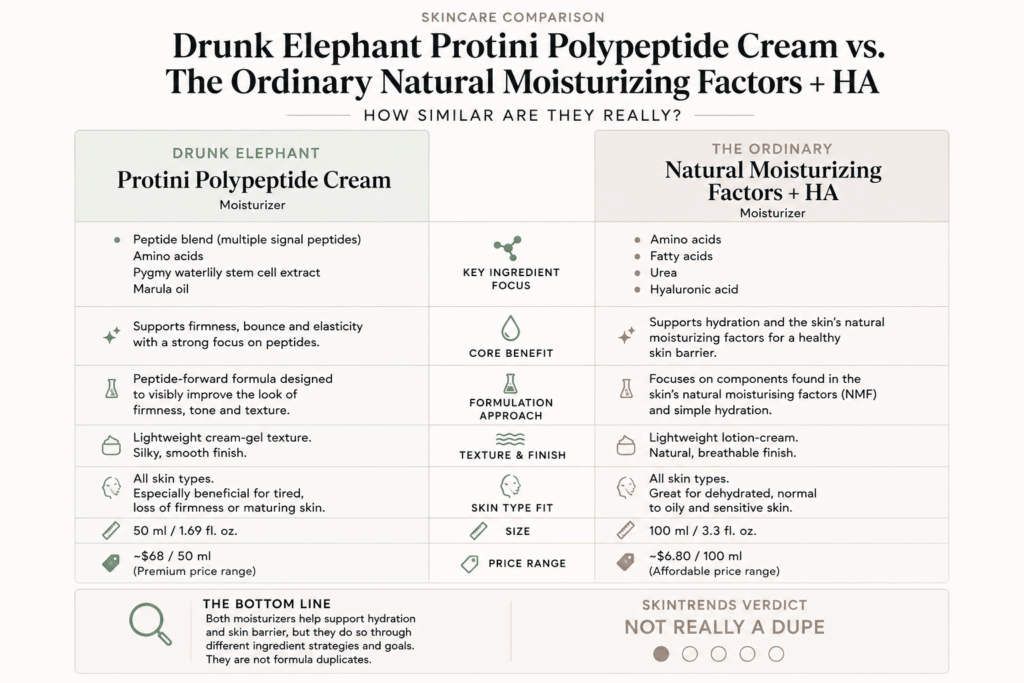
If your only requirement is a dependable moisturiser that helps maintain hydration, a cheaper alternative may satisfy exactly what you need. If you are specifically trying to reproduce Protini’s peptide-focused formula, choosing another moisturiser simply because it serves a similar purpose is not the same thing.
NOT REALLY A DUPE
A lower-priced product can be a perfectly good alternative without being a genuine duplicate.
4.Tatcha The Dewy Skin Cream vs. The INKEY List Water Cream
Luxury moisturisers present an interesting challenge for dupe culture because part of what people pay for extends beyond basic hydration.
Tatcha The Dewy Skin Cream is known for its rich texture and luminous finish. It is designed to create an experience as well as moisturise the skin.
The INKEY List Water Cream sits at a very different price point and offers a much more straightforward approach to hydration.
Both products can leave skin feeling moisturised and plumper. That shared outcome explains why affordable moisturisers often enter conversations about replacing more expensive creams.
However, similar results do not necessarily mean similar products.
Texture, richness, ingredients and the overall sensory experience can differ considerably. Someone whose priority is simply comfortable, hydrated skin may decide that those differences do not justify paying more. Someone who loves the particular feel and finish of Tatcha may disagree.
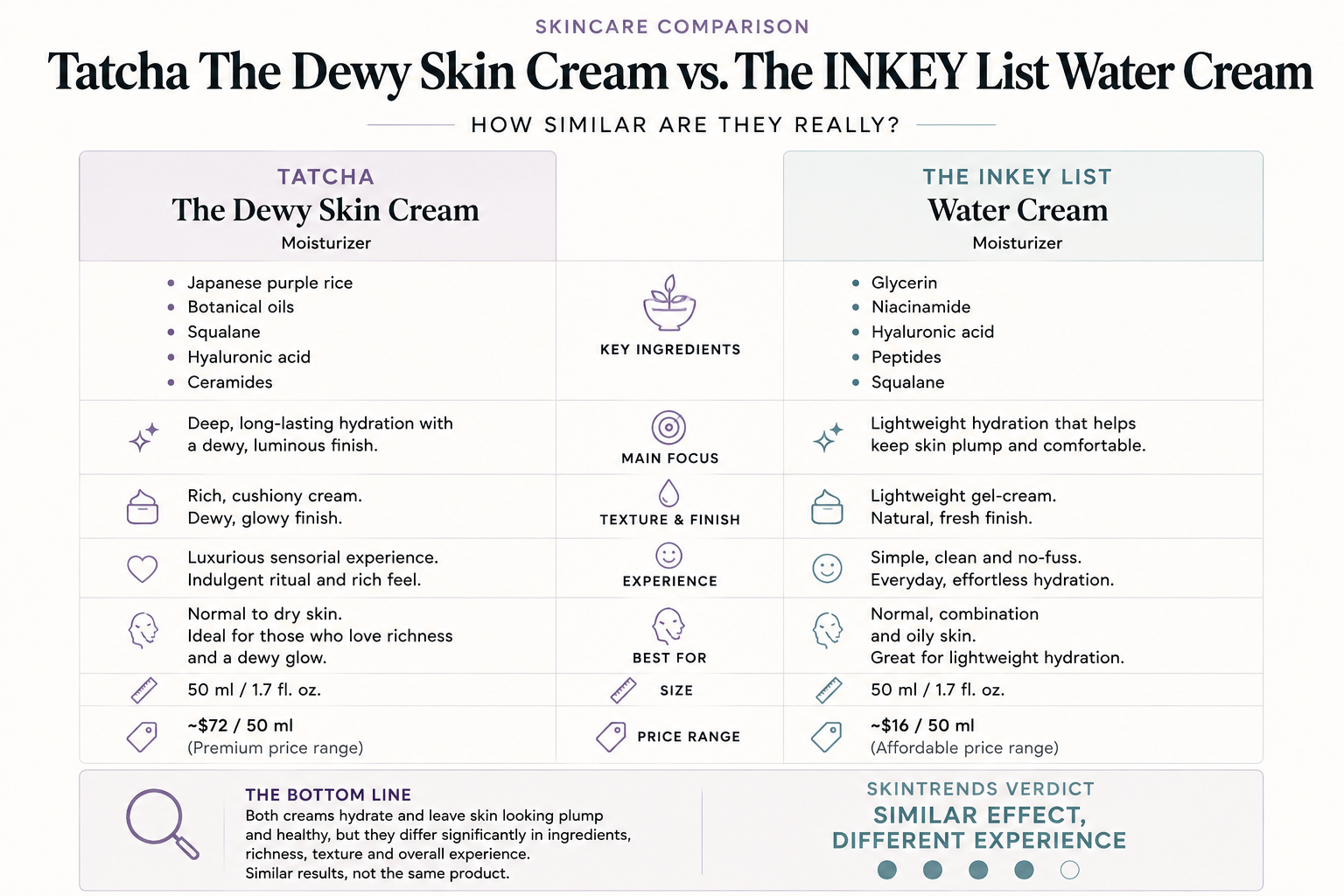
SIMILAR EFFECT, DIFFERENT EXPERIENCE
This is perhaps the most useful form of dupe for some consumers: not a copy, but a cheaper way of achieving the result they actually care about.
5.Drunk Elephant Virgin Marula Luxury Facial Oil vs. The Ordinary 100% Cold-Pressed Virgin Marula Oil
This may be the most intriguing comparison of the group.
Drunk Elephant sells a facial oil built around virgin marula oil. The Ordinary also offers a product based on cold-pressed virgin marula oil, but at a dramatically different price.
On paper, it seems like the easiest dupe verdict imaginable.
If both products are essentially marula oil, what exactly is left to compare?
Quite a lot, potentially.
The source and quality of a raw material, extraction and processing methods, storage, packaging and exposure to light and oxygen can all influence an oil before it reaches the skin. Two products built around the same botanical ingredient can also differ in colour, scent, absorption and overall sensory experience.
None of that automatically proves that the more expensive oil is better.
It simply demonstrates why comparing ingredient names alone cannot tell us everything about a finished skincare product.
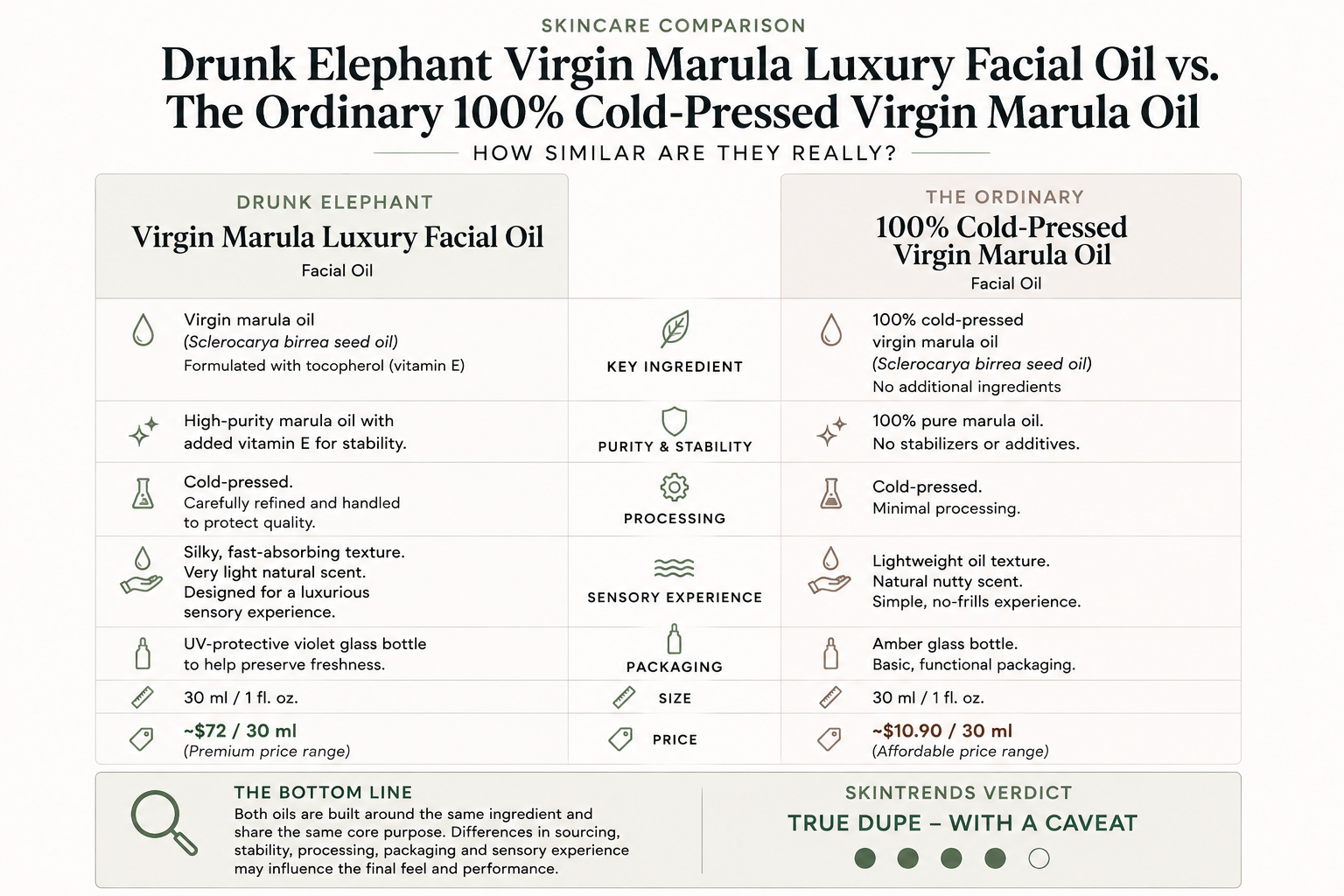
This pair comes closer than most to the traditional idea of a dupe, because the fundamental product concept is exceptionally similar.
TRUE DUPE — WITH A CAVEAT
When formulas are this simple, the case for paying substantially more becomes particularly interesting. But identical ingredient names still do not guarantee an identical experience.
6.Supergoop! Unseen Sunscreen vs. Trader Joe’s Daily Facial Sunscreen
Sunscreen changes the rules.
Supergoop! Unseen Sunscreen became popular partly because it solved a familiar problem: many people want daily sun protection without the traditional feel of sunscreen.
Its invisible appearance and smooth, primer-like texture became part of the product’s identity. Trader Joe’s Daily Facial Sunscreen attracted attention because it offers a remarkably similar concept at a much lower price.
From a sensory perspective, the dupe argument is easy to understand.
But SPF products are not ordinary moisturisers.
The UV filters, formulation and testing behind a sunscreen determine its protective performance. Similar texture or appearance cannot establish that two sunscreens provide identical protection in real-world use.
That means the word dupe needs particular care here.
A cheaper sunscreen may successfully recreate the invisible finish and comfortable application that made another product popular. That does not automatically make the underlying formulas equivalent.
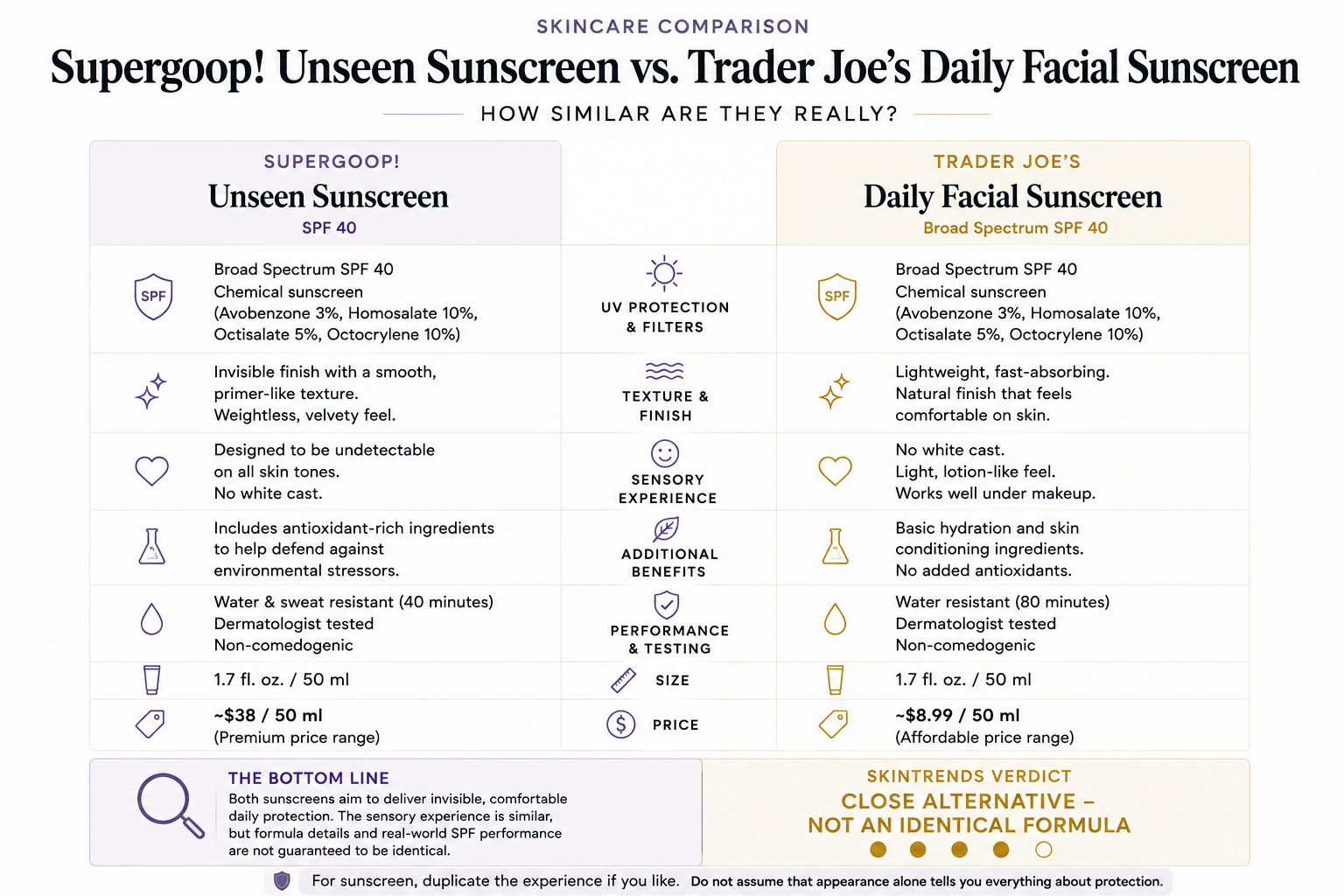
CLOSE ALTERNATIVE — NOT AN IDENTICAL FORMULA
For sunscreen, duplicate the experience if you like. Do not assume that appearance alone tells you everything about protection.
And What Happens When the Dupe Is Makeup?
Skincare exposes the weaknesses of the word dupe because formulation matters so much.
Makeup gives us an interesting contrast.
Here, consumers are often looking for something much easier to observe: Does it create a similar colour? Does it have a similar finish? Does it blend in a similar way? Does it last?
Two of the internet’s most famous beauty comparisons show why dupe culture works rather differently once we move away from skincare.
7.Charlotte Tilbury Hollywood Flawless Filter vs. e.l.f. Halo Glow Liquid Filter
This may be one of modern beauty’s most recognisable dupe comparisons.
Both products sit somewhere between makeup and glow-enhancing complexion products. They can be worn alone, mixed with other products or used to add luminosity to selected areas of the face.
The similarities in concept are obvious, which explains why e.l.f. Halo Glow became so closely associated with Charlotte Tilbury’s Hollywood Flawless Filter.
Still, users do not universally experience them as identical.
Shade, undertone, texture and the way a luminous product interacts with different skin types can change the final result significantly.
In makeup, however, perfect ingredient similarity matters far less. If someone achieves the finish they wanted at a lower price, the alternative may function as a dupe regardless of what is happening inside the bottle.
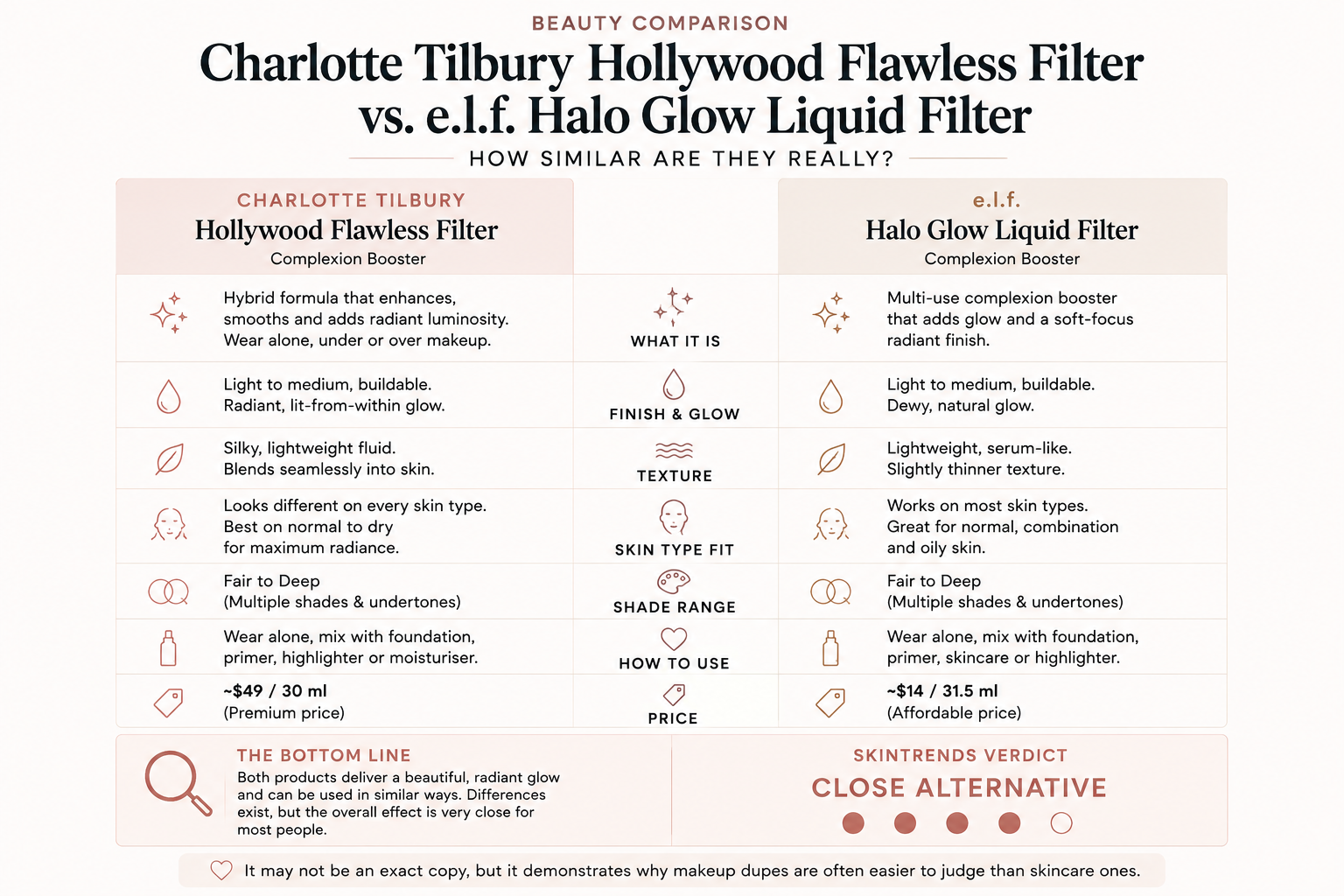
CLOSE ALTERNATIVE
It may not be an exact copy, but it demonstrates why makeup dupes are often easier to judge than skincare ones.
8.Rare Beauty Soft Pinch Liquid Blush vs. e.l.f. Camo Liquid Blush
Rare Beauty helped make highly pigmented liquid blush one of the defining makeup formats of recent years.
When e.l.f. introduced Camo Liquid Blush at a much lower price, comparisons were inevitable.
Both products offer concentrated colour in a liquid format, and both require a relatively small amount of product to create a noticeable result.
Yet pigmentation alone does not make two blushes identical.
Blendability, working time, shade selection, finish and wear can all affect whether someone considers one product a convincing replacement for another.
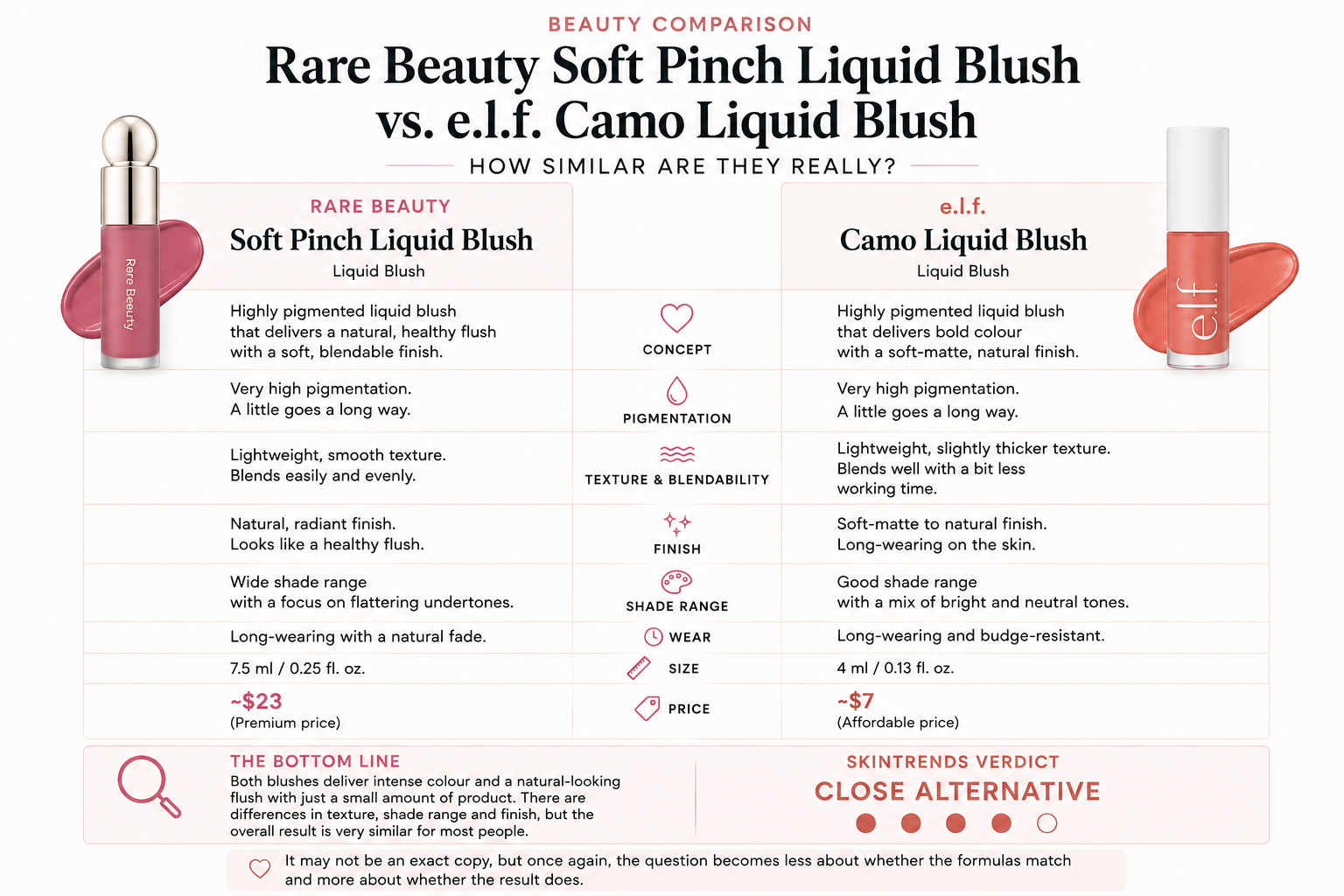
Still, this is exactly the kind of category where a dupe can make practical sense. A consumer looking for the overall experience of a pigmented liquid blush may care much more about the final appearance than about reproducing the original formula.
CLOSE ALTERNATIVE
And once again, the question becomes less about whether the formulas match and more about whether the result does.
Maybe We Need to Rethink What “Dupe” Means
After looking at these comparisons, one thing becomes clear: dupe is an unusually flexible word.
Sometimes it describes two products built around similar ingredients. Sometimes it means similar texture. Elsewhere, the formulas may have little in common while the final effect looks surprisingly alike.
That does not make dupe culture useless.
Quite the opposite.
Affordable alternatives can make beauty more accessible, and a lower price does not automatically mean poorer performance. Expensive products can also offer formulation, research, sensory qualities or specific characteristics that a cheaper alternative does not reproduce.
The problem begins when cheaper alternative and identical product become the same thing.
They are not.
Perhaps the most useful question is therefore not:
“Is this a dupe?”
Instead, ask:
“What exactly do I want to duplicate?”
The ingredients? The texture? The result?
Once you know the answer, finding a less expensive alternative becomes much more meaningful than finding something the internet happens to call a dupe.