You’ve probably seen “pH-balanced” written on cleansers, body washes, shampoos and intimate-care products. It sounds reassuringly scientific — as though someone in a lab has carefully adjusted the formula until it is perfectly in tune with your skin.
But balanced to what, exactly?
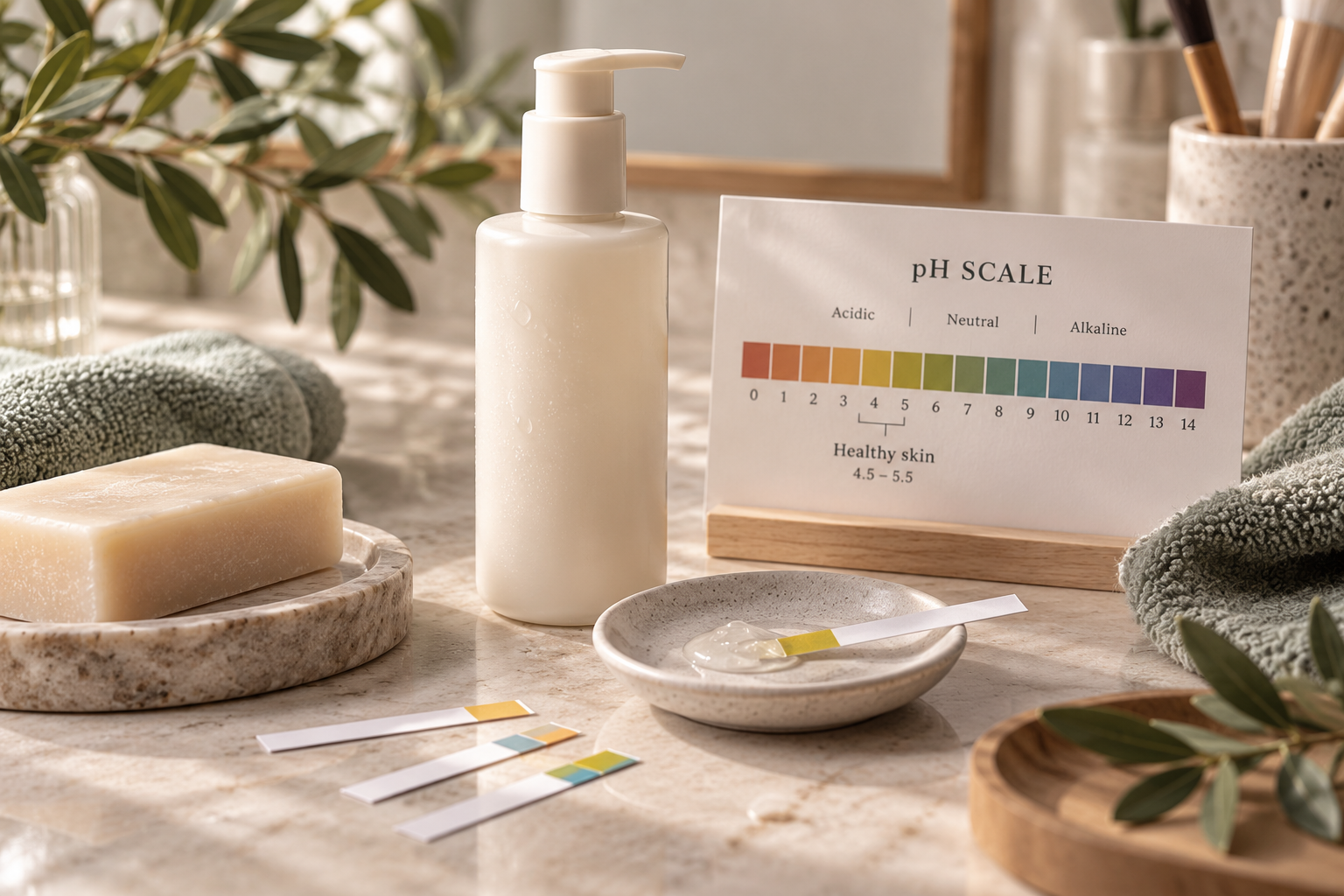
To understand the label, we only need a tiny amount of chemistry. pH is simply a way of describing how acidic or alkaline something is. The familiar scale runs from 0 to 14: 7 is neutral, anything below it is acidic and anything above it is alkaline.
And here’s the first slightly surprising part: healthy skin isn’t neutral.
Your Skin Actually Likes Things a Little Acidic
The surface of the skin naturally tends to be mildly acidic. You’ll often see a range of roughly pH 4.5–5.5 quoted, although there isn’t one magical number that applies to every person and every part of the body.
This slightly acidic environment is associated with what is commonly called the acid mantle. Despite the dramatic name, it isn’t a separate protective sheet sitting on top of your face. Think of it more as part of the chemical environment at the skin’s surface.
And that environment matters. pH influences enzymes involved in normal barrier function and also helps shape the conditions in which the microorganisms living on our skin exist.
So when skincare brands talk about respecting the skin’s natural pH, there is genuine biology behind the idea.
Why Cleansers Get So Much Attention
Cleansing is where pH becomes particularly relevant.
Traditional soap is usually alkaline — often somewhere around pH 9 or 10. Washing with it can temporarily raise the pH at the skin’s surface before the skin gradually moves back towards its usual acidic state.
For many people, occasionally using ordinary soap isn’t going to cause some dramatic skin disaster. The acid mantle isn’t a piece of glass that shatters because you washed your face with the wrong thing once.
But repeatedly using highly alkaline or otherwise harsh cleansers can be less comfortable, particularly if your skin is already dry, sensitive or irritated. That’s one reason many modern facial cleansers are formulated closer to the skin’s naturally acidic range.
Suddenly, that little “pH 5.5” on the bottle makes considerably more sense.
So Does “pH-Balanced” Mean It’s a Good Product?
Not necessarily.
This is where a useful scientific idea becomes a very convenient marketing phrase.
A cleanser can have a skin-friendly pH and still be too drying for you. It might contain fragrance you don’t tolerate well, use a cleansing system your skin dislikes or simply be wrong for your particular needs.
Likewise, a perfectly good cleanser doesn’t need PH-BALANCED printed across the front in enormous letters to have been formulated appropriately.
That’s because pH is one property of a formula, not a quality score.
There is another problem with the phrase itself: balanced is surprisingly vague.
Balanced for your face? Your scalp? Your intimate area? These parts of the body don’t all have identical environments, so the words “pH-balanced” alone don’t necessarily tell you very much about the actual number.
A product that states its measured pH or pH range is giving you more specific information than one that simply tells you it is “balanced.”
And pH Isn’t Only About Cleansers
This is where skincare chemistry becomes a little more interesting.
The performance of some active ingredients can depend partly on the pH of the finished formula. L-ascorbic acid — the classic form of vitamin C — is commonly formulated at a relatively low pH. Exfoliating acids such as glycolic acid are another good example: knowing that a product contains a certain percentage of acid doesn’t tell you everything about how strongly it may behave.
In other words, “10% acid” isn’t the whole formula. The surrounding chemistry matters too.
You don’t need to calculate any of this before buying skincare. That’s the formulator’s job, thankfully. But it does explain why comparing products purely by the percentage printed on the front can sometimes be misleading.
Should You Look for “pH-Balanced” Skincare?
You certainly don’t need to reject the phrase. Unlike plenty of vague beauty language, there is real science behind the importance of skin pH.
Just don’t treat it as a seal of approval.
For cleansers in particular, a formula designed around the skin’s naturally mildly acidic environment can make sense, especially for people prone to dryness or sensitivity. But pH is still only one part of what determines whether a product will work well for you.
So the next time “pH-balanced” catches your eye on a bottle, you’ll know what it is actually trying to tell you.
It’s useful information.
Just not the whole story.