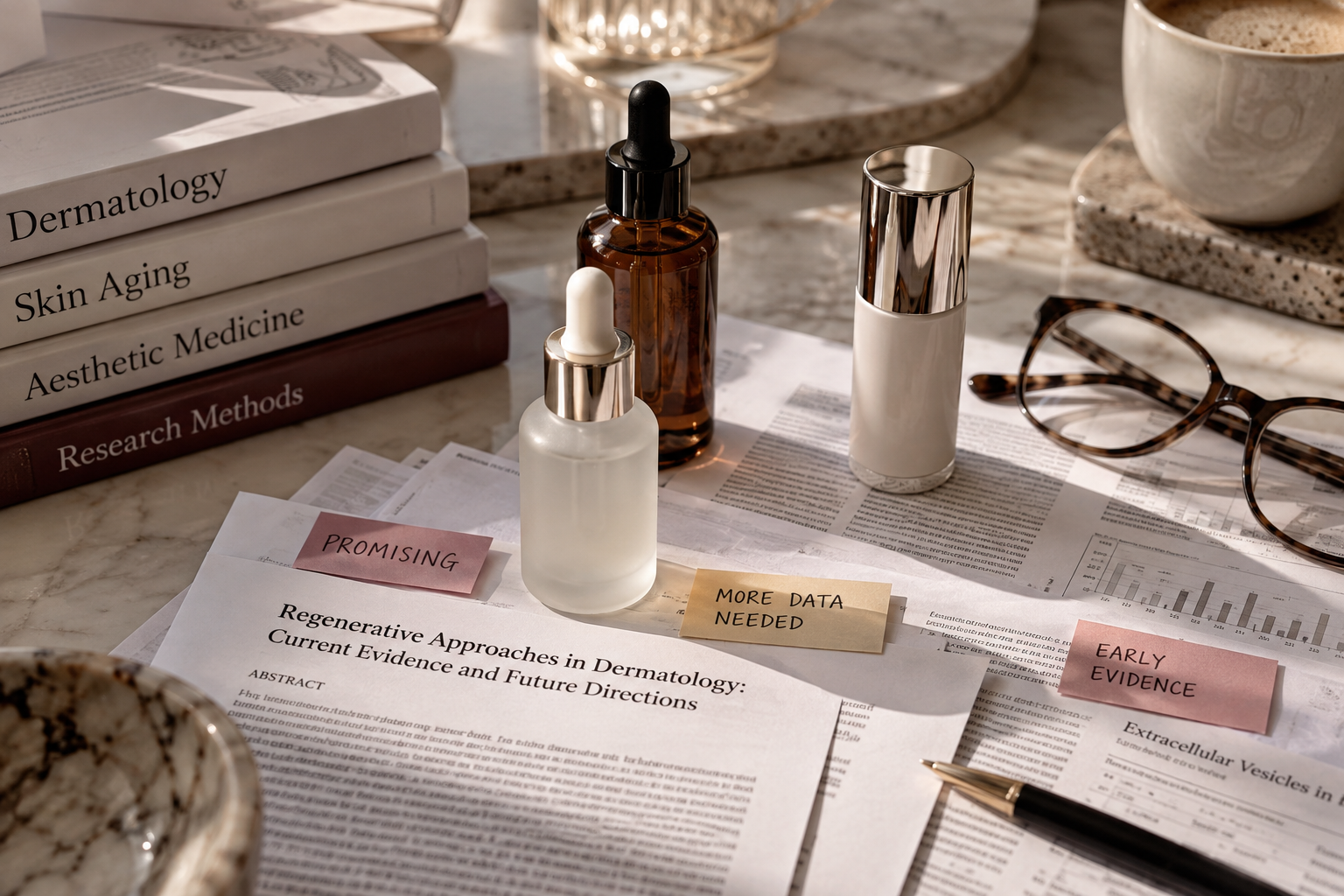
Skincare used to sell us products. Increasingly, it sells us ingredients.
We don’t just buy an anti-aging serum anymore. We buy the peptide serum, the PDRN cream, the exosome treatment – preferably with the star ingredient printed prominently enough on the bottle to make sure we know exactly which skincare era we’re living through.
Ingredients have become beauty celebrities. One starts appearing in a handful of products, someone explains its impressive biological mechanism on TikTok and, within months, it can feel as though every brand has discovered the same thing at exactly the same time.
There is just one awkward problem: science doesn’t move nearly as quickly as skincare trends do.
Promising and Proven Aren’t the Same Thing
A recent Good Housekeeping analysis of 368 anti-aging serums shows just how ingredient-driven skincare has become. Peptides appeared in 137 products, while newer names such as PDRN and exosomes are increasingly joining the category.
But these ingredients aren’t at the same point scientifically – and that’s where things get interesting.
Peptides, for example, aren’t particularly new. They’ve been used in skincare for years and have accumulated human research behind them. A recent systematic review and meta-analysis covering 19 randomized trials and 1,341 participants found improvements across several measures associated with skin aging, although results varied depending on the peptide and formulation studied.
That’s an important detail. “Contains peptides” isn’t the same thing as “this particular product has been proven to work.” Different peptides, concentrations and formulations can produce different results.
And that distinction becomes even more important with skincare’s newer stars.
PDRN Has a Very Good Story – With a Catch
PDRN already had associations with regenerative medicine and Korean aesthetic treatments before it started appearing all over skincare shelves, so the excitement didn’t come from nowhere.
A 2026 systematic review found encouraging results for PN and PDRN in areas including skin rejuvenation, scars and wound healing. But it also found only seven randomized trials involving 183 participants, with researchers noting small samples and differences between study protocols.
More importantly, much of PDRN’s reputation comes from professional and injectable applications.
Your serum is not an injection.
There is emerging research into topical PDRN too. One recent study of a specific 0.1% PDRN eye cream reported promising improvements in photoaged skin after 28 days. That’s genuinely interesting.
What it doesn’t prove is that every PDRN serum currently appearing in your feed will do the same thing.
And that gives us one of the most useful rules in modern skincare:
Evidence that an ingredient can work isn’t evidence that every product containing it will work.
Exosomes Are Even Further Ahead of the Evidence
Then we get to exosomes.
They’re tiny extracellular vesicles involved in communication between cells, which makes them fascinating scientifically – and almost irresistible to beauty marketing. Words like cell signaling, regeneration and cellular communication practically write the advertisement themselves.
Early research is promising, but the evidence is still developing. A 2026 systematic review found potential short-term improvements in hydration, elasticity, wrinkles and pigmentation, but most of the 19 included human studies weren’t randomized and longer-term data were limited.
Another recent review screened 2,394 publications on topical exosomes for skin rejuvenation. Only 18 ultimately met its criteria, and the researchers also found considerable variation and missing information among commercially available exosome products.
That doesn’t mean exosomes are nonsense.
It means something much less dramatic:
we don’t know enough yet.
Unfortunately, “promising technology requiring larger controlled studies” doesn’t look nearly as exciting on a serum bottle as CELLULAR REGENERATION.
The Hype May Simply Arrive Before the Verdict
This is really the bigger story.
Scientific evidence takes time. An interesting mechanism needs to be tested in humans. A topical formulation has to actually deliver the ingredient. Results need to be reproduced, safety considered and ideally larger studies performed.
Beauty culture doesn’t have to wait.
A fascinating mechanism, an impressive ingredient name, a few before-and-after pictures and one viral video can create a must-have ingredient almost overnight. By the time the evidence catches up, social media may already have moved on to the next one.
That doesn’t automatically make the product bad or the marketing dishonest. Sometimes the early excitement will eventually be justified.
The hype may simply have arrived before the verdict.
So perhaps the next time an ingredient suddenly appears everywhere, the useful question isn’t “Should I buy it?” but “What exactly has been proven?”
Has it been tested on people? Perhaps its reputation comes mainly from injections and professional procedures rather than topical use. And even when research exists, does it apply to the ingredient broadly – or only to one particular formulation? And does clinically studied mean a large body of evidence – or one small trial?
You don’t need to become a cosmetic scientist to buy a serum. But understanding the difference between promising, proven and proven in this particular product makes skincare marketing considerably easier to navigate.
You Don’t Have to Be First
Some of today’s fashionable ingredients may genuinely become tomorrow’s skincare staples. PDRN research is developing, exosome science is worth watching and peptides continue to evolve.
Innovation isn’t the problem.
The strange part is our feeling that we need to own every innovation while the science is still figuring out exactly what it can do.
Perhaps that’s why decades-old ingredients can suddenly feel boring while something with a biotechnology-sounding name becomes irresistible overnight. Newness is exciting – and beauty knows it.
The next breakthrough ingredient may genuinely be a breakthrough.
We just don’t always need to buy it before the science has finished introducing itself.