You know your skin type. You know which cleanser works for you. You may even know which ingredients should never share the same evening routine.
But do you know whether your water is hard or soft? Probably not. And yet water is the first thing many of us put on our faces every morning and the last thing we rinse them with at night.
If you have ever moved house, travelled to another city or stayed in a hotel and suddenly thought, Why does my skin feel completely different here? — the answer may not be your skincare at all. It could be the water.
First Things First: What Is Hard Water?
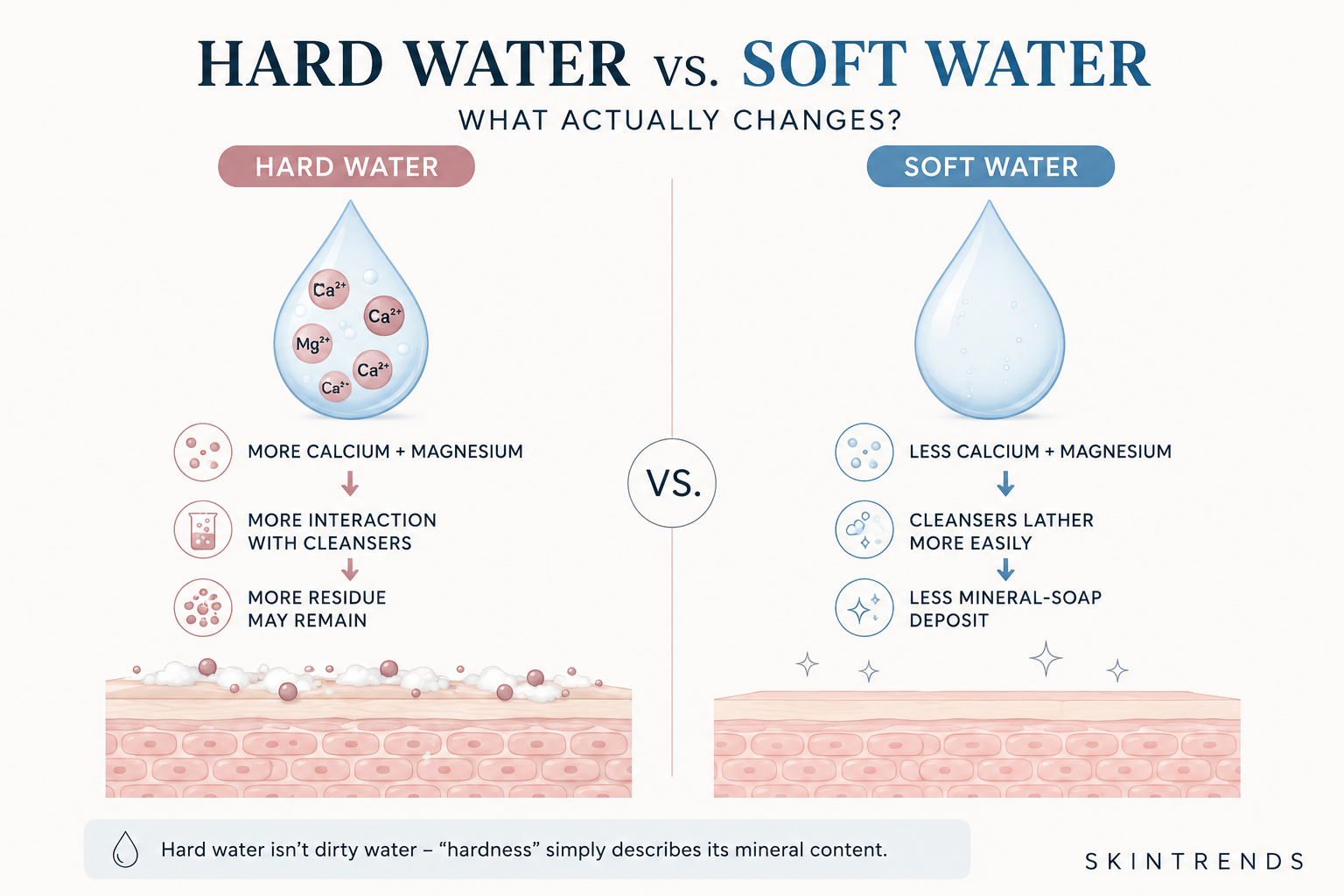
Hard water is not dirty water, and it does not necessarily mean there is anything wrong with your tap water. It simply contains relatively high levels of dissolved minerals, particularly calcium and magnesium.
As water travels through the ground, it passes through rocks and soil and picks up minerals along the way. Areas with lots of limestone, for example, often end up with harder water. Soft water contains much less of these minerals.
You usually cannot tell the difference by looking at a glass of water. But your bathroom may already be giving you clues. Those stubborn white marks around the tap? The cloudy film on the shower screen? The kettle that seems to develop limescale five minutes after you clean it?
There is a good chance you are living with hard water. And if you are currently nodding while looking suspiciously towards your bathroom, you are definitely not alone.
Your Skin May Notice It Too
Here is where things become more interesting. Hard water does not simply touch your skin and somehow “dry it out” because it contains minerals. The relationship appears to be more complicated than that.
Calcium and magnesium can interact with soaps and cleansing agents and affect how well they rinse away. One controlled study found that washing with hard water left more of the cleansing surfactant sodium lauryl sulfate — SLS — on the skin. Greater SLS deposits were also associated with increased water loss from the skin and irritation.
In normal language? Your cleanser may have left the building, but some of what was in it might not have.
That could help explain an experience many people know very well: you wash your face, dry it and immediately feel as though you need moisturiser. Your skin feels tight, maybe slightly rough, perhaps even a little itchy.
We tend to assume that means we need a richer cream. Sometimes it might be worth looking at what happened before the cream.
Ever Moved Somewhere and Suddenly Hated All Your Skincare?
This is perhaps the most relatable part of the hard-water story.
Imagine using the same cleanser, the same moisturiser and the same routine for months without a problem. Then you move. Suddenly your hair feels different, your shampoo does not seem to lather the same way, your shower glass develops white marks and your skin feels tighter after cleansing.
It is easy to start replacing products. But your skincare routine may not have changed at all. Your water did.
Research has found associations between exposure to harder domestic water and eczema. A large UK Biobank study involving more than 300,000 adults, for example, found that greater water hardness was associated with a higher prevalence of eczema. Importantly, however, the researchers did not establish that hard water was causing new cases of eczema.
That distinction matters. Hard water is not a diagnosis, and finding limescale on your tap does not mean it is responsible for every breakout, dry patch or irritated cheek. But it may be one environmental factor worth considering.
Does Hard Water Cause Acne?
This is where the internet tends to get carried away. Search for hard water and skin, and it does not take long to find claims that it causes acne, clogged pores, premature ageing and almost every other skin concern imaginable.
The evidence is nowhere near that simple.
There is a plausible reason why hard water could make some people’s skin feel less comfortable, particularly through its interaction with cleansing products and the skin barrier. That is very different from saying hard water causes acne.
If your skin suddenly changes after moving somewhere with different water, it is reasonable to consider water as one piece of the puzzle. Just do not make it the villain in every skincare mystery.
The Strange Experience of Washing With Soft Water
There is another side to this story that is rarely discussed. If you have spent years living with hard water and then shower somewhere with very soft water, you may notice something strange: you feel as though the soap will not come off.
You rinse, but your skin still feels slippery. So you rinse again, and somehow it still feels as though there is an invisible layer of product left behind.
Ironically, part of what you are noticing may be the absence of the deposits created when soap interacts with minerals in harder water. Your brain has simply learned what “rinsed clean” feels like under the water you normally use.
Change the water and suddenly clean feels wrong. It is a surprisingly good reminder that some of the things we interpret as signals from our skin are actually just sensations we have become accustomed to.
So Should Everyone Buy a Shower Filter?
Not so fast. This is where another skincare misconception appears.
A shower filter and a water softener are not necessarily the same thing. Many shower filters are designed to reduce things such as chlorine, sediment or certain contaminants. Traditional water softeners specifically reduce hardness by removing or exchanging calcium and magnesium ions.
A shower head marketed as “filtered” therefore does not automatically turn hard water into soft water.
And there is an even bigger reason not to rush out and redesign your plumbing in the name of skincare. Although observational studies have found associations between hard water and eczema, trials of domestic water softeners have not provided convincing evidence that installing one improves established atopic eczema.
So, once again, the answer is less satisfying than a TikTok before-and-after: it is complicated.
What Can You Actually Do?
You do not need to start washing your face with imported spring water.
If you suspect hard water is making your skin uncomfortable, the simplest place to start is your cleansing routine. A gentle cleanser may make more sense than repeatedly stripping the skin in pursuit of that squeaky-clean feeling. Using lukewarm rather than very hot water can also help avoid unnecessary dryness, while moisturising shortly after cleansing can help support the skin barrier.
You can also simply find out how hard your water actually is. Your local water supplier may publish hardness information, and inexpensive home testing strips are available if you are curious.
Because before buying a device to solve a problem, it helps to know whether you actually have the problem.
Maybe It Isn’t Your Moisturiser After All
Skincare encourages us to look for answers inside bottles. When something goes wrong, we change the serum, add another cream, remove an active or buy a gentler cleanser. Sometimes that is exactly what we need to do.
But our skin does not exist separately from the environment around us. Temperature, humidity, sun exposure, air conditioning — and yes, even the water coming out of the bathroom tap — can change the way our skin feels and behaves.
So the next time you travel somewhere and mysteriously love your hair and skin, or move house and suddenly wonder why your perfectly good routine seems to have stopped working, take a look at the taps.
Those little white marks might be telling you something.