
Walk into almost any aesthetic clinic today, and you’ll probably hear one of two names: PDRN or exosomes.
Both are associated with healthier-looking skin.
Both are linked to skin repair and rejuvenation.
Both are becoming increasingly popular in professional treatments—and even in skincare products.
So, are they basically the same thing?
Not at all.
Although they share the same goal, they work in very different ways. Once you understand that difference, it becomes much easier to understand why the skincare world is so excited about both.
One Goal, Two Different Approaches
Imagine your skin as a busy city.
At first glance, you notice the buildings. But what really keeps a city alive isn’t the buildings—it’s the communication.
Traffic lights coordinate movement. Emergency services respond to problems. Phone networks and the internet allow information to travel instantly.
Without communication, even the most beautiful city would quickly stop functioning.
Your skin works in a surprisingly similar way.
Millions of cells are constantly exchanging signals. They decide when to repair damage, produce collagen, calm inflammation, or replace old cells with new ones.
PDRN and exosomes both aim to support these natural processes—but they do it in completely different ways.
What Is PDRN?
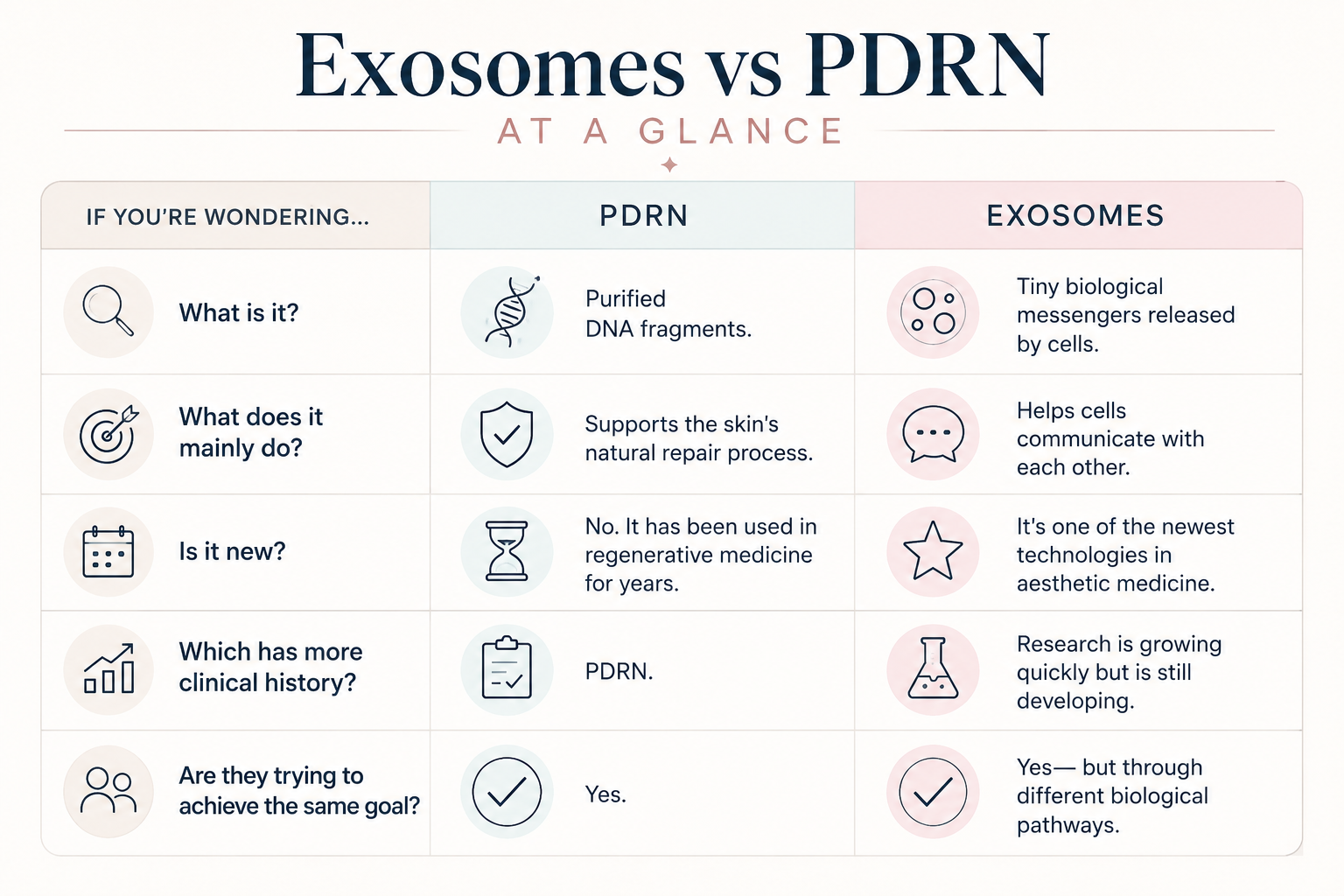
PDRN, short for polydeoxyribonucleotide, consists of small fragments of purified DNA.
While the name sounds intimidating, the idea behind it is actually quite simple.
When skin has been damaged by aging, sun exposure or cosmetic procedures, it needs the right environment to repair itself. PDRN helps create those conditions by supporting the skin’s own healing response.
It doesn’t build new skin on its own.
Instead, it encourages your skin to do what it is already designed to do—repair itself more efficiently.
This is one reason PDRN has been used in regenerative medicine for years before becoming popular in aesthetic treatments.
What Are Exosomes?
If PDRN helps support the repair process, exosomes focus on something different: communication.
Exosomes are tiny particles naturally released by cells. You can think of them as microscopic delivery packages carrying biological messages from one cell to another.
These messages help cells coordinate their activities.
Scientists believe this communication plays an important role in how skin responds to injury, inflammation and aging.
That idea has made exosomes one of the most talked-about technologies in regenerative aesthetics.
However, they’re also one of the newest. While research is expanding rapidly, scientists are still learning exactly which types of exosomes work best, where they should come from, and how they should be produced for consistent results.
Are They Competitors?
Not really.
People often compare PDRN and exosomes as if choosing one automatically means rejecting the other.
In reality, that’s a bit like comparing a construction crew with a communication system.
Both contribute to the same project—but in different ways.
PDRN is mainly associated with supporting the skin’s natural repair environment.
Exosomes are mainly associated with improving how cells communicate during that process.
That’s why many experts don’t see them as direct competitors. Instead, they represent two different scientific approaches to the same goal: helping skin recover and function at its best.
Which One Has Stronger Scientific Evidence?
Both technologies are supported by scientific research, but they are not at the same stage.
PDRN has a longer clinical history. Many studies have investigated its role in supporting tissue repair, particularly in medical settings, before its popularity expanded into cosmetic treatments.
Exosomes are generating enormous scientific interest, but much of the research is still evolving. Scientists continue to study which sources are most effective, how exosomes should be prepared, and which treatments provide the most reliable outcomes.
That doesn’t mean exosomes don’t work.
It simply means the science is still catching up with the excitement surrounding them.
Should You Look for Exosomes or PDRN?
There isn’t a universal winner.
The better question isn’t Which technology is better?
It’s Which treatment is appropriate for my skin and is supported by reliable evidence?
If you’re considering a professional procedure, don’t hesitate to ask your practitioner:
- What kind of product is being used?
- Is there clinical evidence supporting it?
- Why is this treatment recommended for my skin?
- What results are realistic?
Good practitioners welcome these questions.
The Bottom Line
PDRN and exosomes are often mentioned in the same conversation, but they are not the same technology.
PDRN is best known for supporting the skin’s natural repair process.
Exosomes are attracting attention because they help cells communicate in ways that may influence how the skin responds to damage and aging.
Both represent exciting developments in regenerative skincare.
At the same time, neither should be viewed as a miracle solution.
Healthy skin is still built on the basics: daily sun protection, a consistent skincare routine, healthy lifestyle habits and, when appropriate, evidence-based professional treatments.
As research continues, we’ll almost certainly learn much more about both technologies. For now, the most informed approach isn’t choosing whichever ingredient is trending online—it’s understanding what each one actually does and making decisions based on science rather than hype.
Read More: Exosomes – Future of Beuaty Read More: PDRN Serums Explained