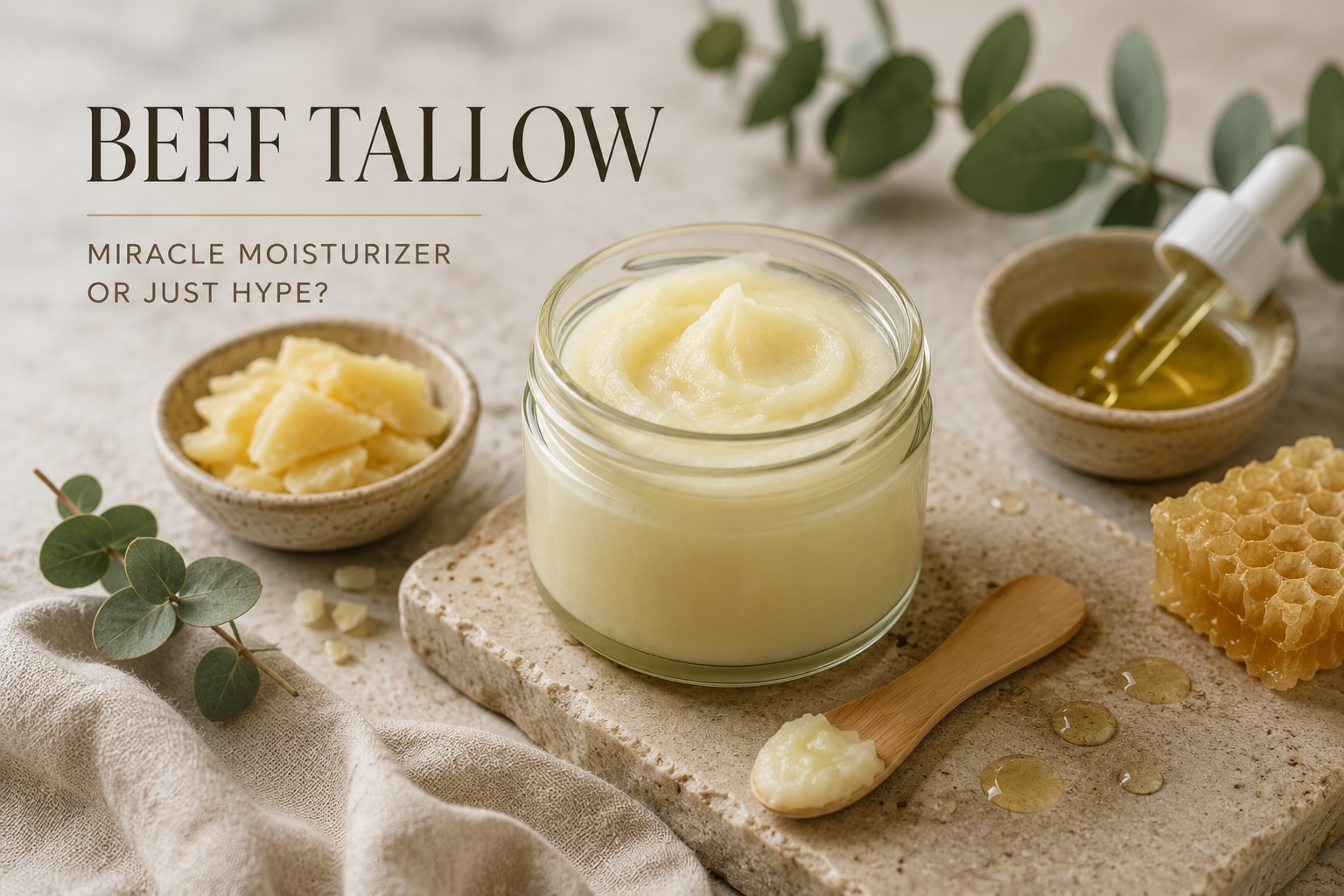
Every few months, social media discovers a new skincare obsession.
One week it’s snail mucin.
The next, it’s salmon DNA.
And lately, one ingredient has been appearing everywhere—from TikTok skincare routines to small artisanal beauty brands:
Beef tallow.
Yes, you read that correctly.
Rendered beef fat.
For many people, the idea sounds unusual, even shocking. Yet thousands of users claim it has transformed their skin, calling it the most natural moisturizer they’ve ever used.
So, is this an ancient skincare secret making a well-deserved comeback?
Or is it simply another viral beauty trend that promises more than it can deliver?
An Ingredient Older Than Modern Skincare
Long before laboratories developed ceramides, peptides, or hyaluronic acid, people relied on ingredients they already had.
Animal fats were commonly used to create soaps, healing balms, and protective ointments. Beef tallow was one of them.
Over time, modern cosmetics replaced these traditional ingredients with formulations that were lighter, easier to preserve, and supported by decades of research.
For years, beef tallow quietly disappeared from mainstream skincare.
Until social media brought it back.
Why Has It Suddenly Become So Popular?
The recent popularity of beef tallow isn’t happening by accident.
It reflects a much larger movement toward “natural” living.
Many consumers are becoming skeptical of long ingredient lists and highly processed products. Instead, they are searching for simpler alternatives that feel closer to nature.
Beef tallow fits perfectly into that philosophy.
Supporters often describe it as “ancestral skincare”—an ingredient our grandparents might have used long before modern beauty shelves existed.
Combined with TikTok videos showing dramatic before-and-after results, it quickly became one of the internet’s most talked-about skincare trends.
Why Do Some People Love It?
Unlike many viral ingredients, beef tallow isn’t completely without merit.
It contains fatty acids that can help soften and protect the skin.
It also naturally contains small amounts of fat-soluble vitamins such as A, D, E, and K.
For people with very dry skin, it can create a rich protective layer that reduces moisture loss.
Some users report that their skin feels calmer, softer, and more comfortable after switching from conventional moisturizers.
That doesn’t necessarily mean beef tallow is repairing the skin in extraordinary ways.
Sometimes, simply reducing water loss is enough to make skin look and feel significantly healthier.
But There Is Another Side to the Story
The biggest mistake would be assuming that “natural” automatically means “better.”
Modern moisturizers aren’t simply mixtures of random chemicals.
Many are carefully formulated with ingredients whose effects have been studied for years.
Ceramides help strengthen the skin barrier.
Niacinamide can reduce redness and support barrier function.
Retinoids remain among the best-studied ingredients for improving signs of aging.
Vitamin C helps protect against environmental damage and supports collagen production.
Beef tallow does not replace these ingredients.
It serves a very different purpose.
Is It Suitable for Every Skin Type?
Probably not.
Someone with extremely dry skin may enjoy the richness that beef tallow provides.
Someone with oily or acne-prone skin may find it too heavy.
Like many occlusive moisturizers, it can leave a thick layer on the skin. Some people love that feeling.
Others don’t.
This is one reason dermatologists are cautious about broad recommendations.
An ingredient that works beautifully for one person may be completely unsuitable for another.
What Does Science Say?
Scientific research on topical beef tallow is still limited.
At the moment, there is no strong evidence showing that it outperforms well-formulated moisturizers in reducing wrinkles, stimulating collagen production, or treating acne.
That doesn’t mean it has no value.
It simply means many of the bold claims circulating on social media have moved much faster than the available scientific evidence.
As with many viral beauty trends, personal experiences are not the same as clinical proof.
The Bigger Lesson
Perhaps the most interesting thing about beef tallow isn’t the ingredient itself.
It’s what its popularity reveals about today’s beauty industry.
Consumers are increasingly looking for authenticity.
They want shorter ingredient lists.
They question marketing claims.
They search for products that feel simple, natural, and trustworthy.
Whether beef tallow becomes a long-term skincare staple or gradually fades like so many internet trends remains to be seen.
Should You Try It?
If you have very dry skin and enjoy experimenting with simple, traditional skincare, beef tallow may be worth exploring—provided you choose products made specifically for cosmetic use and patch-test them first.
If your concerns include acne, pigmentation, or visible signs of aging, it’s important to remember that beef tallow is not a replacement for ingredients with stronger scientific evidence.
Sometimes the biggest lesson from viral skincare trends isn’t discovering a miracle ingredient.
It’s learning to separate curiosity from marketing.
And perhaps that’s exactly why beef tallow has become one of the most fascinating skincare conversations of the year.
The Truth About Collagen Drinks