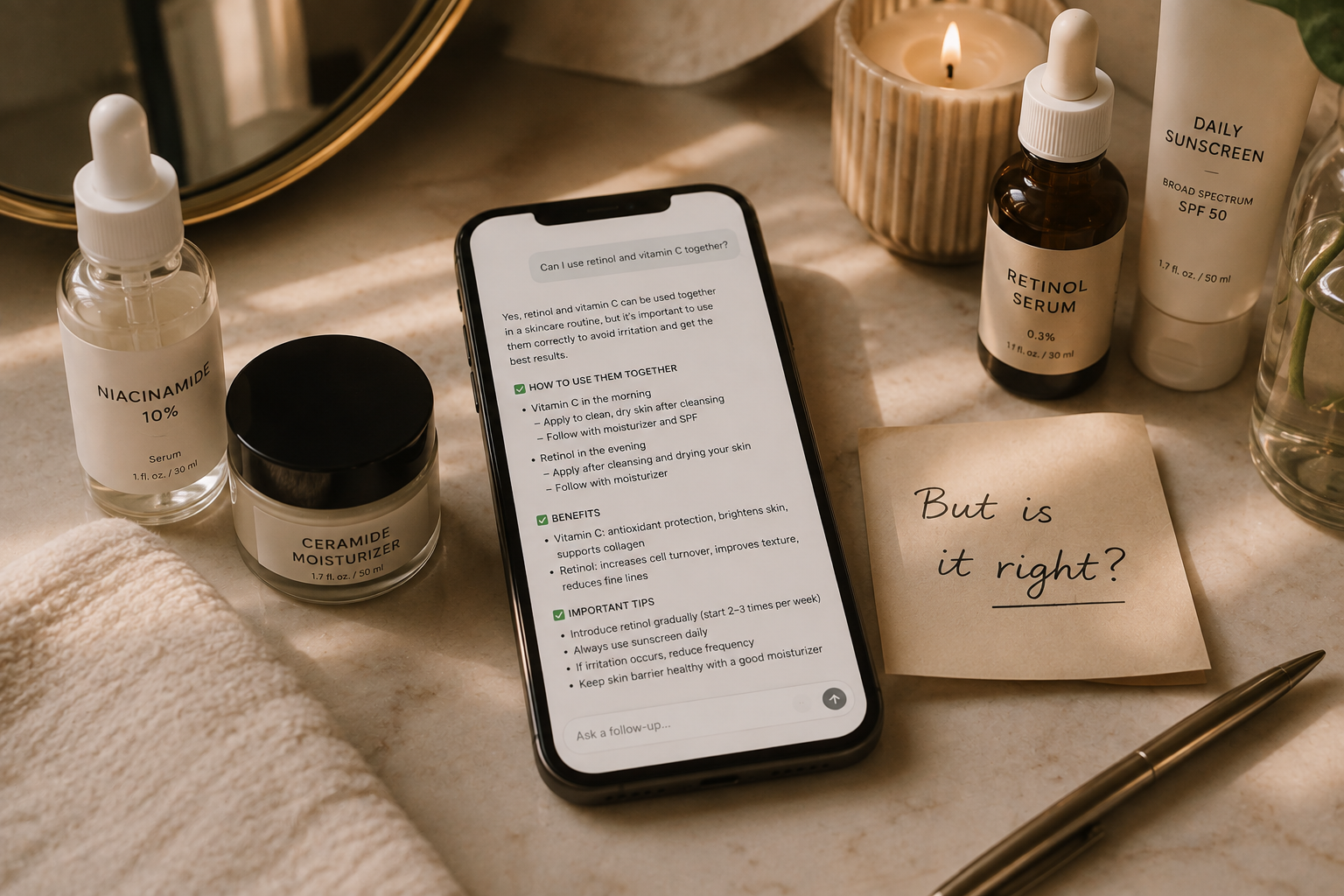
A few years ago, a skincare question usually meant opening Google, reading three articles, finding five different answers and somehow ending up with twelve browser tabs about niacinamide.
Today, you can simply ask AI. And AI skincare advice can sound surprisingly personal, specific and convincing.
Tell it that your skin feels dry, list the products on your bathroom shelf and ask what to use tonight. Within seconds, you may receive a beautifully organized morning and evening routine, complete with explanations of every ingredient.
It is fast, convenient and often genuinely useful.
But there is a question we probably need to ask before handing over our bathroom shelf: how much should we actually trust it?
AI Can Be a Very Good Explainer
There are plenty of skincare questions AI is well suited to help with.
What is the difference between an AHA and a BHA? What does niacinamide do? What does a confusing ingredient name mean? Why is SPF recommended after moisturizer? You can even paste a complicated piece of skincare research into an AI assistant and ask for an explanation in plain English.
This ability to organize and simplify information is one of AI’s real strengths.
Research in dermatology reflects some of that promise. Studies have found that large language models can provide useful and often accurate patient information, although researchers repeatedly caution that their answers may be incomplete and should not simply be treated as clinical guidance.
In other words, asking AI to help you understand something can be very different from asking it to decide what is right for your skin.
And that distinction matters.
The More Personal the Question, the More Complicated It Gets
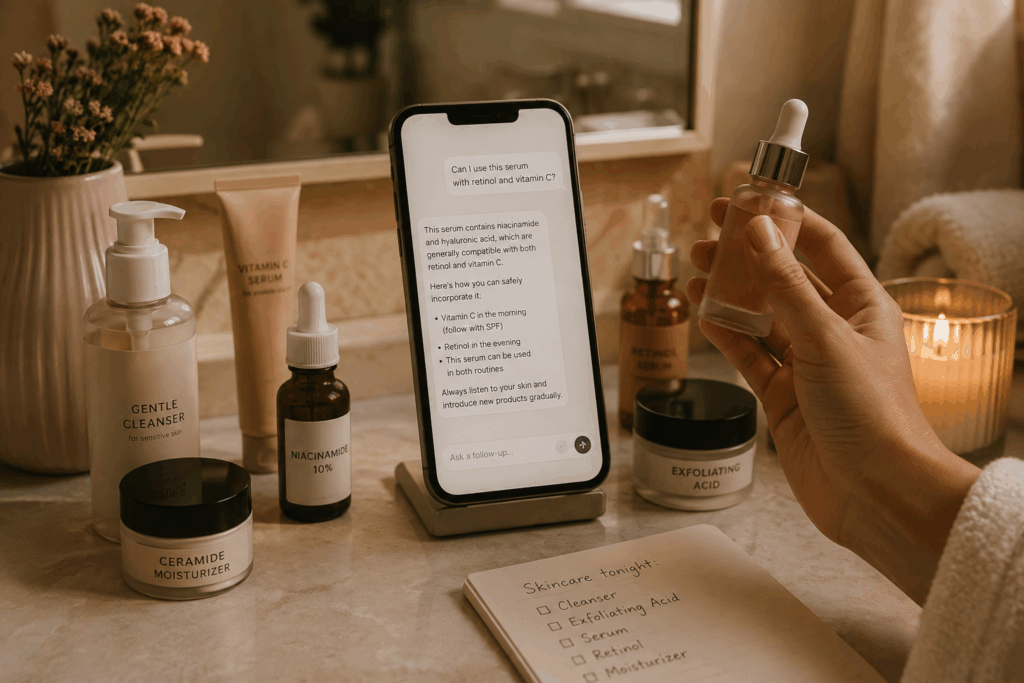
Consider these three questions:
What is retinol?
How should retinol usually be introduced into a skincare routine?
My face is red and peeling after using retinol. What should I do?
They may look like variations of the same skincare question, but they aren’t.
The first is largely informational. The second begins to involve individual circumstances. The third describes symptoms that could require professional assessment.
Yet AI can answer all three in exactly the same calm, polished tone.
That can make it surprisingly easy to forget how much information is missing.
Tell an AI assistant, “I have sensitive skin,” and that may be all it knows about your skin. It hasn’t examined you. It doesn’t necessarily know your medical history, allergies, concentrations of the products you’re using or everything else you’ve applied recently.
More importantly, you may not know which missing detail is important enough to mention.
That is where apparently personalized advice can become misleading. It can feel highly specific because the answer is written specifically for you, while still being based on a very incomplete picture.
The Confidence Problem
This may be the most important thing to understand about asking AI for skincare advice.
AI can be wrong beautifully.
An incorrect answer doesn’t necessarily arrive looking uncertain or suspicious. It can be neatly structured, detailed, reassuring and written with all the confidence of an expert who has answered the same question a thousand times.
Researchers call factually incorrect but plausible AI outputs hallucinations, and they remain a recognized problem in healthcare applications. A 2026 systematic review describes examples including fabricated references and incorrect treatment statements, while a physician-led study of public AI chatbots found problematic responses to medical questions across every system tested.
Dermatology isn’t immune. Research has found examples of hallucinations and inaccurate or incomplete information in dermatology-related AI responses as well.
And there is a strange experience many AI users will already recognize.
Ask a question and receive a confident answer. Challenge it — “I don’t think that’s correct” — and the same assistant may respond with an equally confident apology before presenting a different answer.
That doesn’t mean AI is being dishonest.
It means we shouldn’t interpret the way an AI sounds in the same way we interpret human confidence.
AI confidence isn’t confidence at all. It is presentation.
Fluent language is what these systems are exceptionally good at producing. Fluency, however, is not proof.
AI Isn’t Your Dermatologist or Your Friend
Part of the confusion comes from the format itself.
We talk to AI.
It answers us directly. It remembers what we said earlier in the conversation. It can sound warm, patient or reassuring. It may agree, disagree, explain and apologize.
The interaction feels remarkably human.
But treating the interface as a conversation doesn’t mean we should treat the system as a person.
AI isn’t the colleague who knows your history. It isn’t the friend who remembers what happened to your skin last summer. And however sophisticated its answer sounds, it isn’t a dermatologist who has examined your skin and can take responsibility for a diagnosis or treatment plan.
That distinction becomes particularly important when beauty crosses into health.
There is already evidence that AI can be useful for patient education, but research continues to identify limitations around clinical completeness, hallucinations and safety.
So perhaps we shouldn’t ask whether AI is simply “good” or “bad” at skincare.
We should ask what job we’re giving it.
So, What Should You Ask?
Use AI to help make complicated information easier to navigate. Ask it to explain terminology, help you formulate questions, compare general concepts or organize information you already have.
When the answer starts determining what you personally should put on your skin, introduce, stop or combine, be more cautious. Check important claims against reliable sources, particularly when strong active ingredients are involved.
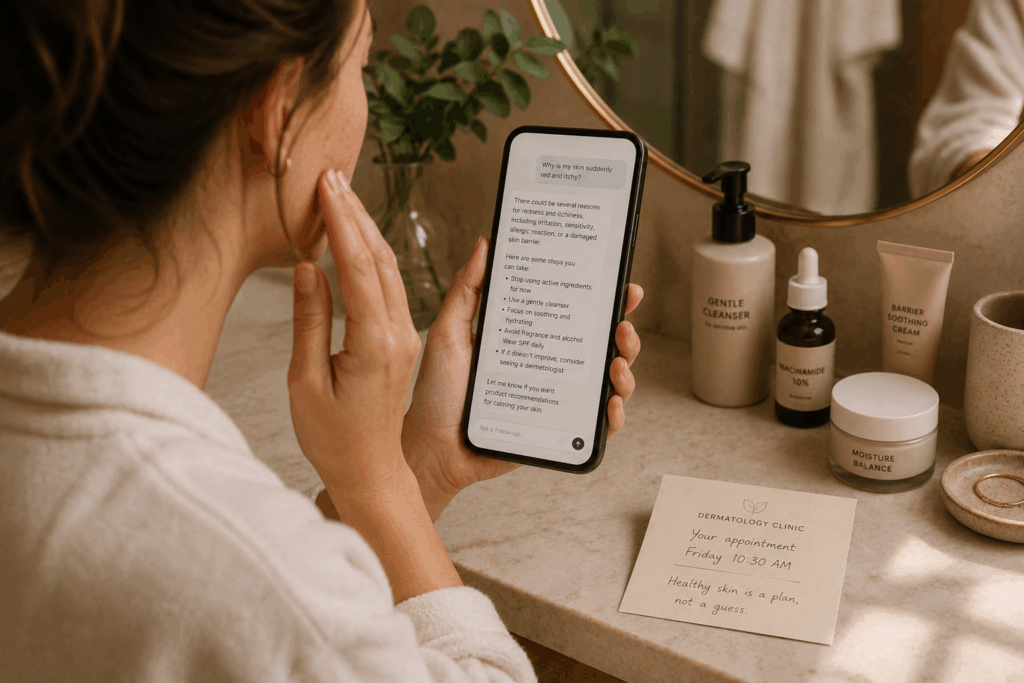
And when the question becomes “What is this rash?”, “Why is my skin burning?” or “What condition do I have?”, the role of AI should change again. Persistent, severe, sudden or concerning symptoms belong with an appropriate healthcare professional, not a chatbot.
AI can still help you understand the information you receive or prepare questions for an appointment. That is very different from asking it to replace the appointment.
A Tool, Not an Authority
AI is going to become part of how we search for beauty and health information. In many ways, it already has.
There is no reason to pretend that isn’t useful. Having a complicated ingredient explained in seconds is useful. Turning pages of information into something understandable is useful. Getting help finding the right questions to ask can be useful too.
But convenience can quietly turn into trust.
And that is where we need to remain awake to what we’re actually using.
AI doesn’t need to become our dermatologist, skincare expert, friend or trusted confidant to be valuable. It can simply be a very capable tool.
Perhaps the healthiest way to use it is also the simplest:
Use AI to understand. Be careful using AI to decide. Don’t use AI to diagnose.
AI can help us find answers. Knowing when not to treat those answers as truth may be the more important skill.