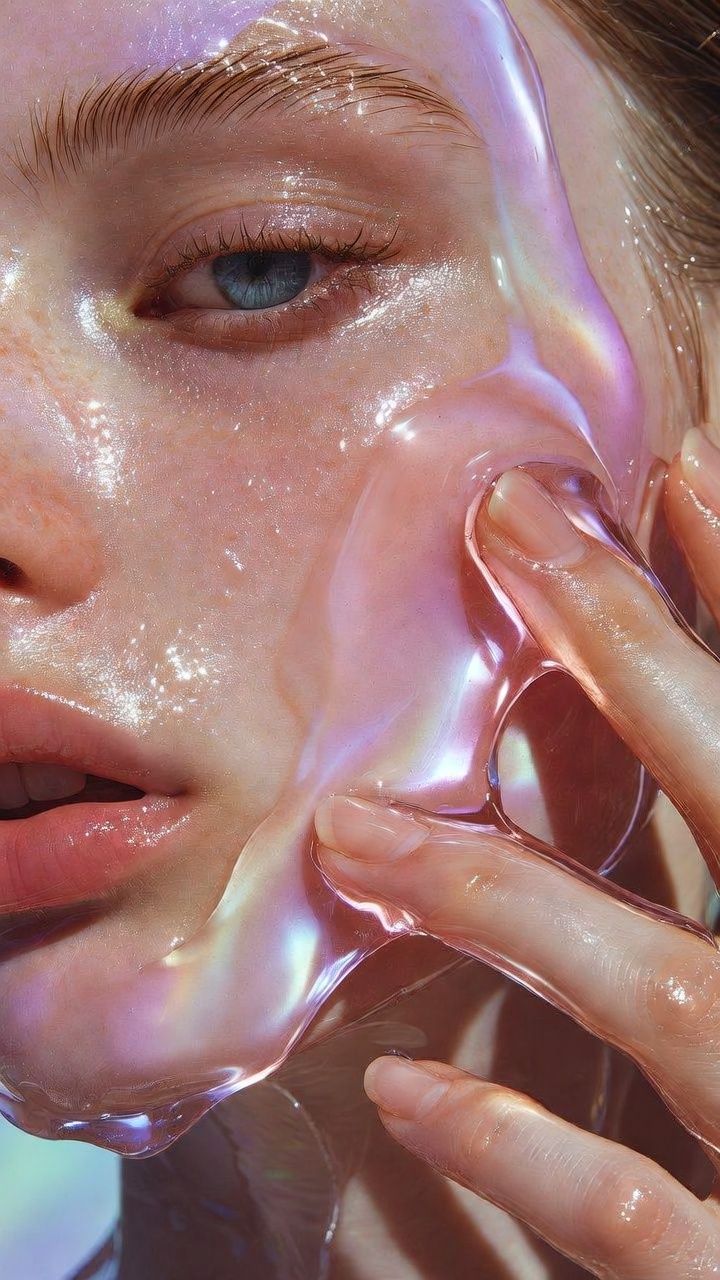
Skincare products have never looked more appealing than they do now.
Creams swirl like whipped desserts. Serums stretch into glossy, reflective layers. Textures bubble, melt, transform, and react on contact with the skin. Entire product launches are built around how satisfying they appear on camera long before anyone discusses what they actually do.
And increasingly, that is the point.
Modern skincare is no longer designed only for the skin. It is designed for the screen.
Texture as visual content
For years, skincare marketing focused primarily on ingredients and results. Products were presented through claims — hydration, brightness, repair, anti-aging. The formula itself remained relatively invisible.
That has changed.
Today, texture has become part of the product’s identity. Creams are engineered to stretch, bounce, shimmer, or break apart in visually satisfying ways. Serums are packaged to catch light perfectly on camera. Masks foam dramatically. Capsule creams burst into color as they are applied.
These reactions are not accidental. They are highly visual details designed to perform online.
The rise of “sensory skincare”
This shift has given rise to what many now describe as sensory skincare — products built as much around experience as effectiveness.
Texture, sound, appearance, and application have become central to how skincare is consumed. A product is no longer judged only by long-term results, but by how enjoyable it feels in the moment and how engaging it appears in a short-form video.
This is why certain textures dominate social media. Glossy gels, jelly-like formulas, whipped creams, and color-changing products all create immediate visual feedback.
They are designed to be watched.
When skincare becomes entertainment
At the same time, the role of skincare itself has started to change.
For many consumers, especially younger audiences, routines are no longer purely functional. They are part of digital identity and daily content creation. Applying skincare is filmed, shared, and aestheticized in ways that previous generations never experienced.
As a result, products are increasingly created with visibility in mind.
A cream that looks dramatic on camera may generate more attention than one with a stronger formulation but no visual impact. Packaging becomes more reflective. Textures become more exaggerated. The line between skincare and entertainment begins to blur.
In some cases, the experience becomes more important than the product itself.
The psychology behind the textures
Part of what makes sensory skincare so effective online is psychological.
Humans naturally respond to texture, movement, and transformation. Smooth surfaces, glossy finishes, and repetitive motions create a form of visual satisfaction that keeps attention engaged. On social media platforms built around rapid stimulation, these small sensory reactions become extremely powerful.
A bubbling cleanser or melting balm does more than demonstrate a product. It creates a moment.
And in digital culture, moments travel faster than formulas.
What gets lost in the process
This does not mean sensory skincare is inherently ineffective. Many of these products are well-formulated and enjoyable to use. Experience has always been part of beauty.
But the balance has shifted.
In some cases, products are optimized first for visibility and second for function. Dramatic textures may attract attention while offering little long-term benefit. Complex application methods can create the illusion of sophistication without necessarily improving results.
The visual performance of the product begins to compete with its actual purpose.
A new phase of beauty culture
Sensory skincare reflects something larger than product design. It reflects the way beauty itself is changing.
Modern beauty is increasingly built around interaction, stimulation, and shareability. Products are expected not only to work, but to create content. A routine is no longer private — it becomes something performed, recorded, and consumed socially.
This changes what brands prioritize.
Skincare is no longer competing only on results.
It is competing for attention.
And in an environment driven by visibility, the products that feel the most satisfying on camera often become the ones people remember most.
Skin Rituals – South Korea: The Origins Behind Modern K-Beauty